
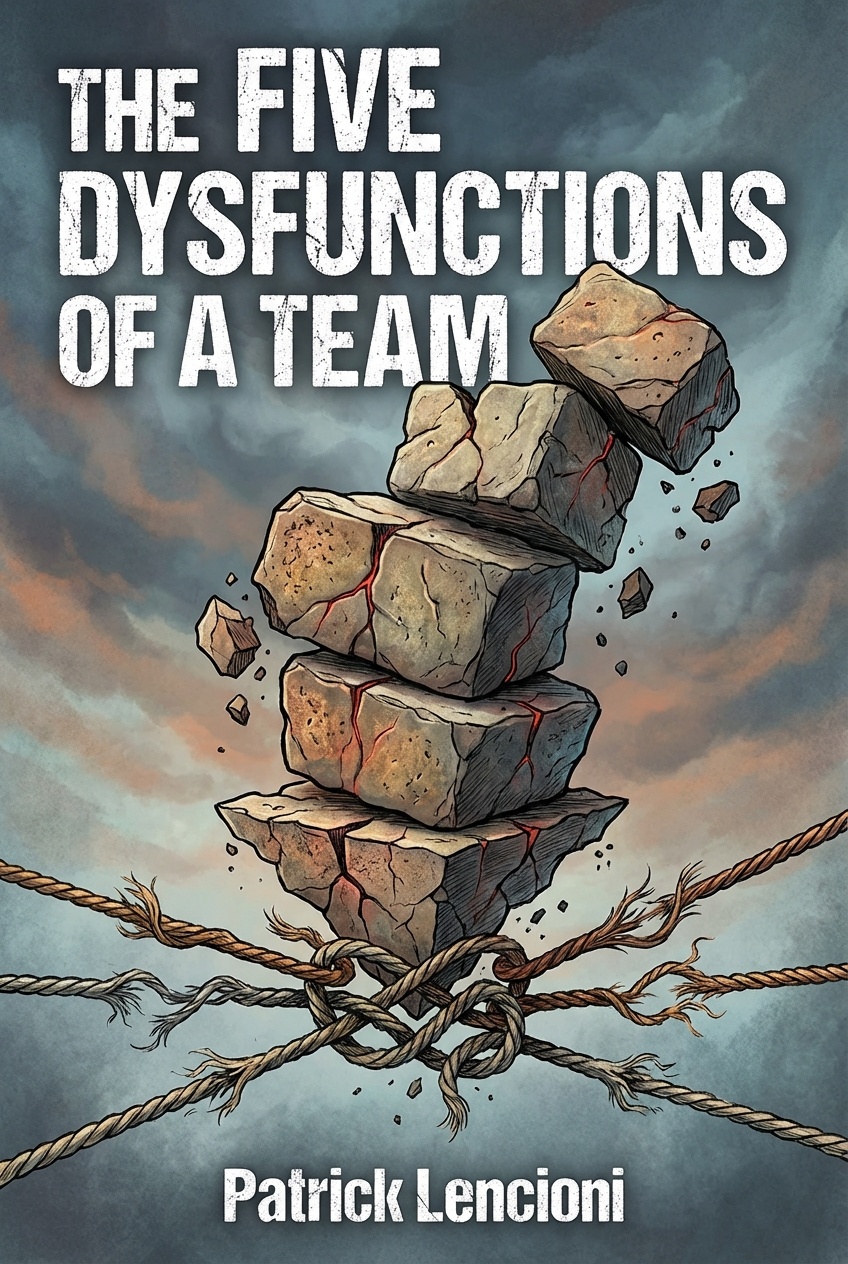
Why You should Read This Book?
This book offers a powerful, practical framework for understanding and overcoming the common dysfunctions that plague teams, from a lack of trust to an inattention to results. It provides clear, actionable steps to diagnose your team's specific challenges and implement real solutions. Read it to build a truly cohesive, high-performing team capable of achieving extraordinary collective success.
Listen to PodcastDialogue turns nonfiction books into engaging podcast mini-series between two hosts, making key ideas easy to absorb on the go. It uses science-backed learning techniques to strengthen memory formation and complements the book's insights with supporting scientific evidence.
The book begins with a narrative fable to illustrate abstract concepts in a real-world setting. It sets the stage by contrasting potential with performance, showing that talent and capital are useless if the team cannot work together.
DecisionTech is presented as a company that should be a massive success. It has the most experienced investors, the smartest engineers, and plenty of cash. However, the company is failing miserably while its competitors are gaining ground. This setup serves as a critical lesson: on paper, the team looks perfect, but in reality, they are broken. The executives are more focused on their own departments and egos than the collective good, illustrating that 'smart' does not equal 'healthy.'
Kathryn Petersen is hired as the new CEO, and she is an anomaly in the tech world. She isn't a computer genius; she is an 'old school' manager with a background in automotive manufacturing. While the board and the employees expect her to immediately announce a new product strategy or marketing pivot, she does nothing of the sort. Instead, she spends her first few weeks simply observing the executives. She realizes the problem isn't the product; it's the people. Her approach highlights that fixing the team's behavior must precede fixing the business strategy.
Kathryn quickly identifies the symptoms of the team's sickness. Their staff meetings are boring, tedious, and lacking in any real drama or passion. Paradoxically, despite the lack of arguing, there is a thick tension in the room. Executives roll their eyes, check their email during discussions, and make sarcastic comments. This environment creates a state of 'artificial harmony,' where everyone is polite on the surface but deeply resentful underneath. No real work gets done because nobody is willing to engage in the messy, necessary debates required to solve problems.
To fix the team, Kathryn mandates a series of two-day executive retreats (off-sites). The executives complain about the time 'wasted' away from their real work, but Kathryn insists. These off-sites are not for golf or trust falls; they are intense working sessions designed to tear down the walls between the members. It is here that Kathryn introduces the model of the Five Dysfunctions. She forces the team to stop talking about operations and start talking about how they treat one another. This illustrates that team building is not a recreational activity, but a rigorous business discipline.
This is the foundation of the pyramid. Without trust, none of the other dysfunctions can be addressed. The book defines trust specifically as the confidence that your peers' intentions are good and that there is no reason to be protective or careful around them.
In the context of a team, trust does not mean predicting how someone will behave (e.g., 'I trust him to be late'). It means 'vulnerability-based trust.' This is the ability to stand in front of your peers and say things like 'I don't know the answer,' 'I made a mistake,' or 'I need help.' When team members are unwilling to be vulnerable, they waste immense amounts of energy managing their behaviors and trying to impress one another. Without this foundation, the team is just a collection of individuals protecting their own turf.
Most successful people are trained to hide their weaknesses to get ahead in their careers. However, on a cohesive team, hiding weaknesses is toxic. When members refuse to admit they are overwhelmed or under-skilled in an area, the team cannot assist them, and small problems grow into disasters. In the book, the executives at DecisionTech constantly posture, refusing to admit when their departments are failing. This invulnerability prevents the team from utilizing the collective strengths of the group to solve problems.
Trust doesn't happen overnight, but it can be accelerated. The book suggests using tools like the 'Personal Histories Exercise,' where members share non-threatening info about their background (e.g., number of siblings, first job). This humanizes colleagues and makes it harder to interpret their behavior negatively. Furthermore, using personality profiles (like Myers-Briggs) helps the team understand that a colleague isn't being annoying on purpose; they just process information differently. These exercises strip away judgment and replace it with empathy.
The leader must go first. If the team leader is not willing to be vulnerable, no one else will be. The leader must debase themselves first, admitting to a flaw or a mistake, to make it safe for others to do the same. If the leader feigns invulnerability, the subordinates will mirror that behavior. Kathryn, the CEO in the book, models this by openly sharing her own past failures and managerial weaknesses, signaling to the arrogant executives that it is safe to drop their guard.
Create a free account to read the remaining themes and key concepts from this book.
Create an accountOnce trust is established, the team must engage in conflict. This dysfunction highlights the difference between destructive fighting and constructive, ideological debate. Teams that lack trust fear conflict because they view it as a personal attack.
Many teams confuse 'being nice' with being a good team. They avoid difficult conversations to spare feelings, resulting in 'artificial harmony.' In the book, the DecisionTech executives would sit through meetings nodding their heads while silently disagreeing. This is dangerous because it suppresses important issues. Great teams argue. They do not argue about personalities or gossip; they argue passionately about concepts, strategies, and ideas. They know that without the friction of debate, they cannot reach the best answer.
When a team avoids conflict, they don't get all the facts on the table. People hold back their true opinions, meaning the final decision is based on incomplete information. This leads to 'meeting after the meeting' behavior, where members complain about the decision in hallways rather than debating it in the room. Avoiding conflict doesn't save time; it wastes it, because the same issues keep resurfacing again and again without ever being truly resolved.
The goal of conflict is to find the truth. When team members trust each other, they know that a challenge to their idea is not a challenge to their intelligence or worth. This allows for 'mining for conflict.' This involves looking for buried disagreements and bringing them to the surface. It requires a mindset shift where the team understands that withholding a contrary opinion is actually a disservice to the company.
Leaders often have a natural instinct to step in and protect their people when a conversation gets heated. This is a mistake. By interrupting the conflict, the leader prevents the team from developing the coping skills to resolve issues themselves. The leader must demonstrate restraint, allowing the debate to reach a natural resolution, even if it feels uncomfortable. It is the leader's job to remind the team that the discomfort they are feeling is good and necessary for growth.
Commitment follows conflict. In the context of the book, commitment is not about everyone agreeing (consensus); it is about everyone buying into a decision even if they disagree with it.
When teams fail to argue and air their opinions (Dysfunction 2), they rarely commit to the final decision. This leads to ambiguity. The team leaves the room with a vague sense of direction, but no one is truly aligned. In the book, this manifested as executives ignoring deadlines or prioritizing their own department's goals over the company's, because they never really agreed to the company's plan in the first place. Without commitment, the team is paralyzed by a lack of clear direction.
Great teams understand that consensus is a trap. It is rare that everyone will agree on the best course of action. Waiting for everyone to agree means waiting forever. Instead, great teams strive for 'buy-in.' This means that even if a team member opposes a decision, they commit to supporting it fully once the leader makes the final call. This is the concept of 'disagree and commit.' They can only do this if they feel their opinion was truly heard and considered during the conflict phase.
Reasonable people do not need to get their way in order to support a decision; they just need to know that their opinions were heard and considered. If a team member feels they were shut down or ignored, they will not commit. The leader must ensure that every voice is extracted during the discussion phase. Once everyone has spoken, the leader can break the tie or make the call, and the team will follow because the process was fair.
Dysfunctional teams are often paralyzed by the need for certainty. They want to delay decisions until they have enough data to be 100% sure they are right. The book argues that a decision is better than no decision. Great teams pride themselves on being able to unite behind a decision even when the outcome is uncertain. They realize that it is better to make a bold decision, be wrong, and pivot quickly, than to waffle and create confusion among the employees.
Once a clear commitment is made, team members must hold each other accountable for sticking to it. This dysfunction refers to the unwillingness of peers to call out their teammates on performance or behaviors that might hurt the team.
This is often the most difficult dysfunction to overcome because it feels 'mean.' Team members naturally want to avoid the interpersonal discomfort of calling out a peer. They feel it isn't their place to correct someone of equal status. In the book, this is illustrated by the character Mikey, the Marketing VP. She was often rude, rolled her eyes, and failed to deliver, but her peers (like Martin, the Chief Technologist) stayed silent because they didn't want the hassle of a fight. They hoped the boss would fix it, but by staying silent, they enabled her toxicity.
When peers fail to hold one another accountable, the general standards of the team begin to erode. If one person misses a deadline or behaves poorly and no one says anything, it sends a signal that such behavior is acceptable. This creates resentment among the high performers who are pulling their weight. Over time, the team drifts into mediocrity because the bar is set by the lowest performing member.
The most effective form of accountability is not from the boss (top-down), but from peers (horizontal). Peer pressure is a powerful motivator because people generally want to let down their boss less than they want to let down their teammates. On a healthy team, if someone is slacking, their peers will immediately ask, 'Hey, we're waiting on that, is everything okay?' This reduces the burden on the leader and creates a culture where everyone is responsible for the results.
While the goal is peer-to-peer accountability, the leader must create the environment for it. If the leader is not willing to hold people accountable, the peers never will. The leader must be the 'ultimate judge,' willing to make the difficult decision to fire or demote someone if they refuse to improve. However, the leader should encourage the team to be the first line of defense, only stepping in when the team fails to police itself.
The ultimate dysfunction is when members care about something other than the collective goals of the group. If the previous four dysfunctions are present, the team will inevitably lose focus on results.
This dysfunction occurs when team members put their own department's success, their career path, or their ego ahead of the company's results. For example, a head of sales might be happy that they hit their sales quota, even if the company as a whole lost money. In a functional team, if the team loses, everyone loses. There is no such thing as a 'winning department' on a losing team. The focus must shift from 'my goals' to 'our goals.'
Some people are driven merely by the status of being on the team. They want to be a 'VP' or sit at the executive table because it feeds their ego, not because they want to achieve specific results. This complacency is dangerous. A results-oriented team is obsessed with outcomes, not titles. They define success not by how hard they worked or how prestigious they look, but by whether they actually achieved what they set out to do.
To combat the distraction of status, teams should make public declarations of what they intend to achieve. Saying 'We will try our best' is weak. Saying 'We will achieve X revenue by Y date' creates pressure, and that pressure is healthy. When a team publicly commits to a specific result, they are much more likely to work passionately to achieve it because they do not want to fail in the public eye.
The leader sets the tone for focus. If the leader constantly changes their mind or focuses on subjective things like 'effort' rather than 'outcome,' the team will lose sight of the goal. The leader must be selfless and objective, reserving rewards and recognition only for those who contribute to the group's goals. If the leader allows team members to prioritize their own careers over the team's success, the dysfunction will spread instantly.
Hear the key concepts from this book as an engaging audio conversation.
Listen to Podcast