
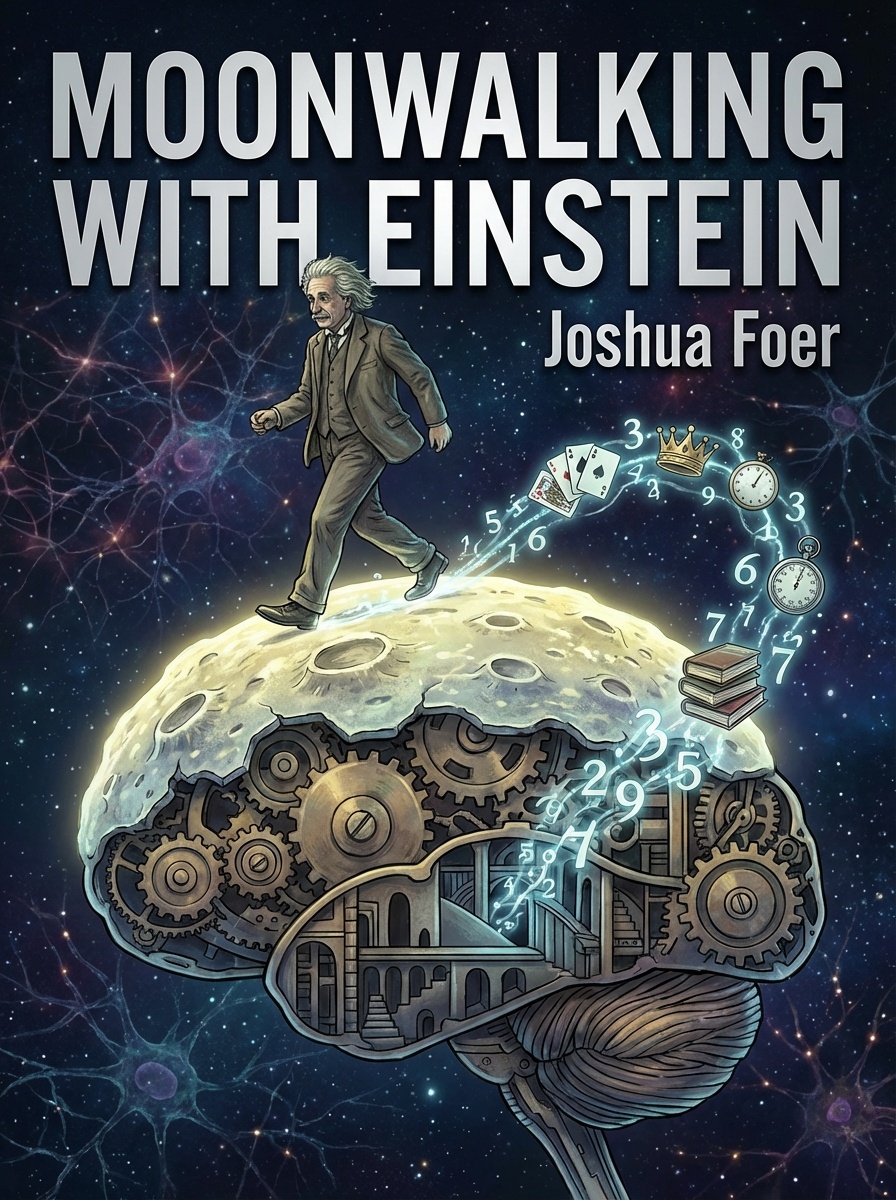
Why You should Read This Book?
This book reveals the incredible potential of the human memory, showing that anyone can achieve feats once thought impossible. Follow journalist Joshua Foer's captivating journey as he trains to become a U.S. Memory Champion, demystifying ancient mnemonic techniques along the way. Reading it will not only entertain and inspire but also equip you with practical strategies to improve your own memory, learning, and overall cognitive abilities.
Listen to PodcastDialogue turns nonfiction books into engaging podcast mini-series between two hosts, making key ideas easy to absorb on the go. It uses science-backed learning techniques to strengthen memory formation and complements the book's insights with supporting scientific evidence.
This theme introduces the hidden subculture of 'mental athletes'—individuals who compete in grueling contests to memorize thousands of numbers, names, and cards. It challenges the common assumption that these people are savants or geniuses. Instead, the book reveals that they are ordinary people who have trained their brains using ancient techniques. It sets the stage for the author's journey from a skeptical journalist to a U.S. Memory Champion, proving that memory is not a fixed trait but a trainable skill.
When the author first attended the U.S. Memory Championship, he expected to find a room full of 'Rain Man' style savants with freakish natural abilities. Instead, he found regular people—some of whom had average or even poor memories in their daily lives—who had trained themselves to perform cognitive feats. They explained that they weren't using raw brainpower; they were using 'software' (techniques) to optimize their 'hardware' (the brain). This pivotal moment debunks the myth that great memory is an innate gift reserved for a lucky few.
The book distinguishes between 'memoria naturalis' (the memory you are born with) and 'memoria technica' (artificial memory tools). Natural memory is the hardware you use to remember your childhood or what you had for breakfast. Artificial memory consists of the internal tools and systems—like the Memory Palace—that act as a scaffold to hold information that the natural memory struggles to retain. The goal of memory training is not to replace natural memory, but to build an artificial infrastructure that works alongside it.
Neuroscience reveals that the brains of memory champions are structurally identical to average brains, but they function differently. fMRI scans show that when champions memorize abstract data, they light up the hippocampus and regions associated with *spatial navigation* and *visual processing*. This relates to the concept of neuroplasticity—the brain's ability to reorganize itself. A famous study of London taxi drivers showed that their hippocampi actually grew larger as they memorized the city's complex layout, proving the brain physically adapts to the demands of memory training.
Historically, a trained memory was considered the cornerstone of character and wisdom. In ancient times, before widespread writing, people carried their culture, laws, and history in their minds. The author discusses the 'externalization' of memory, starting with the invention of writing (which Socrates famously warned would destroy our memory) and accelerating with the internet. As we rely more on external aids like smartphones and Google, our internal capacity to remember has atrophied because we no longer feel the need to exercise it.
This theme covers the core mechanics of how memory training actually works. It moves away from theory and into the specific, practical methods used by experts. The central premise is that our brains are terrible at remembering abstract data (like numbers or text) but incredibly good at remembering images and spaces. By converting the former into the latter, we can hack our biology to achieve superhuman recall.
The Memory Palace is the most famous and essential technique in the book. It is based on a legend about the Greek poet Simonides. After stepping out of a banquet hall, the roof collapsed, crushing everyone inside beyond recognition. Simonides realized he could identify every body based on where they had been sitting. He discovered that human spatial memory is immense. The technique involves visualizing a familiar building (your home) and placing mental images of the things you want to remember in specific locations along a path. To recall the list, you simply 'walk' through the building in your mind.
To make information stick in a Memory Palace, you cannot just visualize a boring object; you must use 'elaborative encoding.' This means transforming a dull item (like a bottle of milk) into something vivid, bizarre, violent, or sexual. The brain is evolutionarily hardwired to pay attention to things that are unusual or critical for survival. A bottle of milk is forgettable; a cow dancing the tango while raining milk on your carpet is unforgettable. The more multi-sensory and emotional the image, the better.
This concept illustrates the difference between remembering a name and a concept. If you tell someone a man is a 'baker' (profession), they will likely remember it because the word triggers a web of associations: the smell of bread, a white hat, flour, an apron. If you tell someone the man's last name is 'Baker' (proper noun), they often forget it because the name is an abstract label with no hooks. Memory works by connecting new information to existing webs of meaning. To remember a name, you must turn it into a concept.
The Major System is a code that converts abstract numbers into phonetic sounds, which can then be turned into words and images. Since the brain struggles to remember the number '32,' the system assigns the sound 'M' to 3 and 'N' to 2. '32' becomes 'M-N,' which you can fill with vowels to make 'MoN' (Man) or 'MooN.' By converting a string of digits into a series of visualizable nouns, you can place them in a Memory Palace. It turns the most difficult data (numbers) into the easiest data (pictures).
Create a free account to read the remaining themes and key concepts from this book.
Create an accountThis theme follows the author's rigorous year-long training regimen. It explores the psychology of expertise and the specific hurdles one faces when trying to master a new skill. It emphasizes that improvement isn't just about spending time; it's about how that time is spent. The section details the advanced systems used to handle massive amounts of data and the mental discipline required to compete.
Drawing on the research of K. Anders Ericsson, the book explains that 'practice makes perfect' is a lie; only 'deliberate practice' creates expertise. Simply doing a task repeatedly (like driving a car) doesn't make you better at it once you know the basics. Deliberate practice involves three things: focusing on technique, staying goal-oriented, and getting immediate feedback. It requires stepping outside your comfort zone and constantly attempting things that are just beyond your current ability.
The 'OK Plateau' is the point in skill acquisition where you become good enough to perform a task on autopilot (autonomous stage). For example, once you learn to type without looking, your speed stops increasing because you stop paying conscious attention. To improve, you must force yourself back into the 'cognitive stage' where you are thinking about every keystroke. Memory athletes constantly fight the OK Plateau by analyzing their mistakes and forcing themselves to go faster than they can handle until their brain adapts.
To memorize long sequences of numbers or cards, athletes use 'chunking' to compress data. The most advanced method is the Person-Action-Object (PAO) system. Every two-digit number (00-99) is assigned a specific Person, an Action they do, and an Object. For example, '32' might be Michael Jordan (Person) dunking (Action) a basketball (Object). When memorizing a 6-digit number, you take the Person from the first pair, the Action from the second, and the Object from the third to create one unique, complex image. This compresses 6 digits into a single scene.
The author's training involved more than just mental exercises; it required cultivating intense focus. He describes wearing earmuffs and 'memory goggles' (glasses with the lenses taped over except for small pinholes) to block out all peripheral distractions. This highlights that memory is largely an act of attention. You cannot remember what you do not pay attention to. The regimen was about clearing the mind of noise so that the visualization techniques could work without interference.
This section steps away from the competition to look at the outliers: people with amnesia and people with 'savant' syndromes. These stories serve as scientific controls, helping to explain how memory functions by showing what happens when it breaks or when it works too well. It deconstructs the myths surrounding 'photographic' memory and reinforces the link between memory and our perception of time and self.
The book explores the world of savants, specifically Daniel Tammet, who claimed to recite Pi to 22,514 digits due to synesthesia (seeing numbers as colors/shapes). However, the author investigates and suggests that many 'savants' might actually be using the same mnemonic techniques as the memory champions, but they have internalized them so deeply (or subconsciously) that it feels natural. This blurs the line between innate genius and trained skill, suggesting that even 'magical' memory might be a form of extreme, obsessive practice.
The author introduces EP, a man with severe amnesia caused by a virus that destroyed his temporal lobes. EP lives in an 'eternal present,' forgetting everything that happens within minutes. Despite this, he can navigate his neighborhood and make tea. This proves the distinction between declarative memory (facts/events) and non-declarative memory (habits). EP's tragic story illustrates that without memory, we lose our ability to perceive the passage of time and our ability to grow as individuals. We are, quite literally, the sum of our memories.
The book systematically debunks the idea of 'photographic' (eidetic) memory in adults. Scientific tests, including the search for a woman named 'Elizabeth' who supposedly had this power, have largely failed to find anyone who can take a mental snapshot and read details from it later. Most people who claim to have photographic memory are actually using highly developed association techniques or have obsessive interests (like baseball stats) that allow them to chunk information effortlessly.
Comparing the brains of memory champions to those of amnesiacs and normal people confirms that there is no 'super-memory' brain structure. The difference lies entirely in how the brain is deployed. Memory athletes bypass the brain's natural limitations for abstract data by rerouting that data through the visual and spatial centers. It is a software upgrade (learning to think in images) rather than a hardware upgrade (growing a bigger brain).
The final theme covers the culmination of the author's journey at the U.S. Memory Championship and his subsequent reflections. It reconciles the incredible feat of winning with the mundane reality that he still forgets his car keys. The book concludes with a philosophical argument for the value of memory in the digital age, suggesting that building an internal library of knowledge is essential for creativity, wisdom, and being a fully realized human.
The author competes in the U.S. Memory Championship, specifically excelling in the 'Speed Cards' event. Using his trained PAO system and Memory Palaces, he memorizes a shuffled deck of cards in under two minutes, winning the tournament. This moment serves as the proof of concept: a regular journalist with one year of training defeated seasoned competitors. It validates the entire premise of the book—that with deliberate practice and the right techniques, the human mind is capable of extraordinary feats.
Despite winning the championship, the author admits he still forgets where he put his car keys and still needs to write down to-do lists. This highlights a critical lesson: memory techniques are 'domain-specific.' They work for the things you actively apply them to (like a deck of cards or a speech), but they do not magically upgrade your general awareness. You must be mindful to turn the technique on; it doesn't run in the background automatically.
The book argues that the more you know, the easier it is to learn. Memory works by association—hooking new information onto old information. A person with a vast internal library of facts (history, literature, science) has more 'hooks' available to catch new information. This contradicts the modern idea that we don't need to know facts because we have Google. Without an internal web of knowledge, you cannot read deeply, understand context, or make creative connections.
Ultimately, the book concludes that memory is the root of our humanity. Our ability to recall the past allows us to plan for the future and understand our present. In a world that encourages us to externalize everything to devices, cultivating a strong memory is an act of preserving our own minds. A trained memory fosters attention, presence, and a richer inner life. We are only as rich as the memories we keep.
Hear the key concepts from this book as an engaging audio conversation.
Listen to Podcast