
Why You should Read This Book?
This book is an indispensable guide for parents and caregivers seeking to understand and implement authentic Montessori principles for children from birth to age three. It offers clear, practical advice on creating a supportive home environment, fostering independence, and observing your child's unique developmental needs, all rooted in Paula Polk Lillard's deep expertise. Read it to confidently nurture your child's natural love for learning and create a harmonious foundation for their earliest years.
Listen to PodcastDialogue turns nonfiction books into engaging podcast mini-series between two hosts, making key ideas easy to absorb on the go. It uses science-backed learning techniques to strengthen memory formation and complements the book's insights with supporting scientific evidence.
The Montessori approach to the first three years of life is built on a profound respect for the infant as a capable, self-constructing human being. Rather than viewing babies as helpless creatures who need things done to them, this philosophy recognizes that infants are actively building their own minds and bodies from the moment of birth. The adult's job is not to mold the child like clay, but to provide the right environment and gentle guidance so the child can unfold naturally. This requires a massive shift from traditional parenting, moving away from constant entertainment and intervention toward careful observation and thoughtful preparation.
Children are not empty vessels waiting to be filled with knowledge by adults; they are active participants in their own creation. From birth, infants possess an internal drive to develop their physical and mental faculties. They learn by interacting with the world around them, absorbing information like a sponge. This process of self-formation means that true education starts at birth and is driven by the child's own inner timetable. Adults must trust this natural process and avoid the temptation to rush or force development. Instead of trying to teach a baby how to sit or walk, we must provide opportunities for them to practice these skills when they show readiness. By respecting their timeline, we allow them to build a strong foundation of self-confidence and autonomy.
The physical space a child inhabits is considered the third teacher in the Montessori philosophy. A prepared environment is one that is carefully designed to meet the specific developmental needs of the child at their current stage. It must be safe, beautiful, orderly, and scaled down to the child's size. When a home is set up with the child in mind, it removes unnecessary barriers to their independence and allows them to explore freely without constant adult intervention. This means having low shelves with a few carefully chosen toys, child-sized furniture, and accessible materials. A well-prepared environment fosters a sense of security and encourages the child to engage deeply with their surroundings.
In the Montessori framework, the adult is not a traditional teacher or a boss, but rather a gentle guide and a keen observer. To be a prepared adult means doing the inner work to manage your own ego, impatience, and desire for control. It requires stepping back and allowing the child to struggle slightly, as this struggle is essential for learning and building resilience. The guide's role is to connect the child to the prepared environment, show them how to use materials purposefully, and then fade into the background. This delicate dance of knowing when to step in and when to step back is the hallmark of a prepared adult. It requires immense patience and a deep trust in the child's capabilities.
Children are born with universal human tendencies, such as the drive to explore, to communicate, to work, and to create order. Alongside these tendencies, children go through sensitive periods, which are windows of time when they are intensely focused on and uniquely capable of acquiring a specific skill, like language or coordinated movement. During a sensitive period, learning happens almost effortlessly. If this window is missed, learning that same skill later requires conscious, arduous effort. Recognizing these periods is crucial because it allows parents to provide the exact right materials and opportunities at the exact right time, aligning with the child's natural developmental urges.
The first few months of life are a period of massive transition for the newborn, moving from the confined, dark, and aquatic environment of the womb to the bright, expansive world outside. The Montessori approach to this stage focuses on easing this transition by creating a calm, nurturing, and highly predictable environment. It emphasizes the importance of respecting the infant's need for physical freedom to develop their movement and the critical link between their developing hands and their growing brain.
A Montessori nursery looks very different from a traditional one. It eschews the standard crib with high bars in favor of a floor bed, which allows the child visual freedom and, eventually, the physical freedom to get in and out of bed independently. The room is kept simple, uncluttered, and visually calming, with artwork hung low at the baby's eye level. A designated movement area with a soft mat and a low mirror allows the infant to observe their own body and practice unhindered movement. In one book story, an infant transitioning to a floor bed naturally rolled off the low mattress onto the soft rug beside it. Instead of being trapped behind crib bars crying for an adult, the baby explored the edge of the bed, learned the spatial boundary of their sleeping area, and eventually learned to roll back onto the mattress, gaining an early sense of spatial awareness and independence.
Movement is not just physical exercise for an infant; it is the primary way they build their intelligence. From the initial involuntary reflexes to the highly coordinated act of walking, every movement helps wire the brain. The Montessori method emphasizes giving babies maximum freedom to move. This means avoiding restrictive devices like bouncers, swings, walkers, or tightly swaddling them for long periods while awake. Infants need to spend ample time on a flat, firm surface where they can stretch, kick, and eventually learn to roll, crawl, and pull up. The adult's role is to provide enticing objects just out of reach to motivate this movement, rather than physically manipulating the child's body into positions they cannot achieve on their own.
Maria Montessori famously referred to the hand as the instrument of man's intelligence. In the first three years, the development of the hand is intimately linked to the development of the brain. As infants learn to grasp, release, and manipulate objects, they are gathering vital data about the physical world, such as texture, weight, temperature, and shape. This tactile feedback builds cognitive pathways. Therefore, it is crucial to provide infants with a variety of natural materials to explore with their hands and mouths. Simple, beautifully crafted wooden rattles, fabric balls, and everyday household objects are far superior to plastic, battery-operated toys that do the playing for the child.
For a young child, external order brings internal peace. Infants and toddlers have a profound, almost rigid need for consistency in their environment and their daily routines. Because the world is so new and overwhelming, knowing exactly where things belong and what will happen next provides a deep sense of security. When a child's environment is chaotic or their schedule is unpredictable, they often exhibit distress, tantrums, and anxiety. Establishing a predictable rhythm for sleeping, eating, and playing helps the child orient themselves in time and space, allowing them to focus their energy on learning and growing rather than worrying about what is coming next.
Create a free account to read the remaining themes and key concepts from this book.
Create an accountPractical life activities are the cornerstone of the Montessori approach for toddlers. These are the everyday tasks of living, such as washing, dressing, cleaning, and preparing food. While adults often view these chores as drudgery to be finished quickly, toddlers view them as fascinating opportunities to participate in real life. By engaging in practical life, children develop fine and gross motor skills, improve their concentration, and build a profound sense of self-worth and independence.
From a very young age, children want to take care of their own bodies. The Montessori method encourages parents to set up the environment so toddlers can succeed in self-care tasks like dressing, brushing hair, and washing hands. This requires providing child-sized tools, such as a low mirror, a small hairbrush, and clothing that is easy to put on and take off. When adults take the time to break down these tasks into slow, manageable steps and allow the child to practice, the child learns that they are capable and responsible for themselves. This builds immense confidence and reduces power struggles over daily routines.
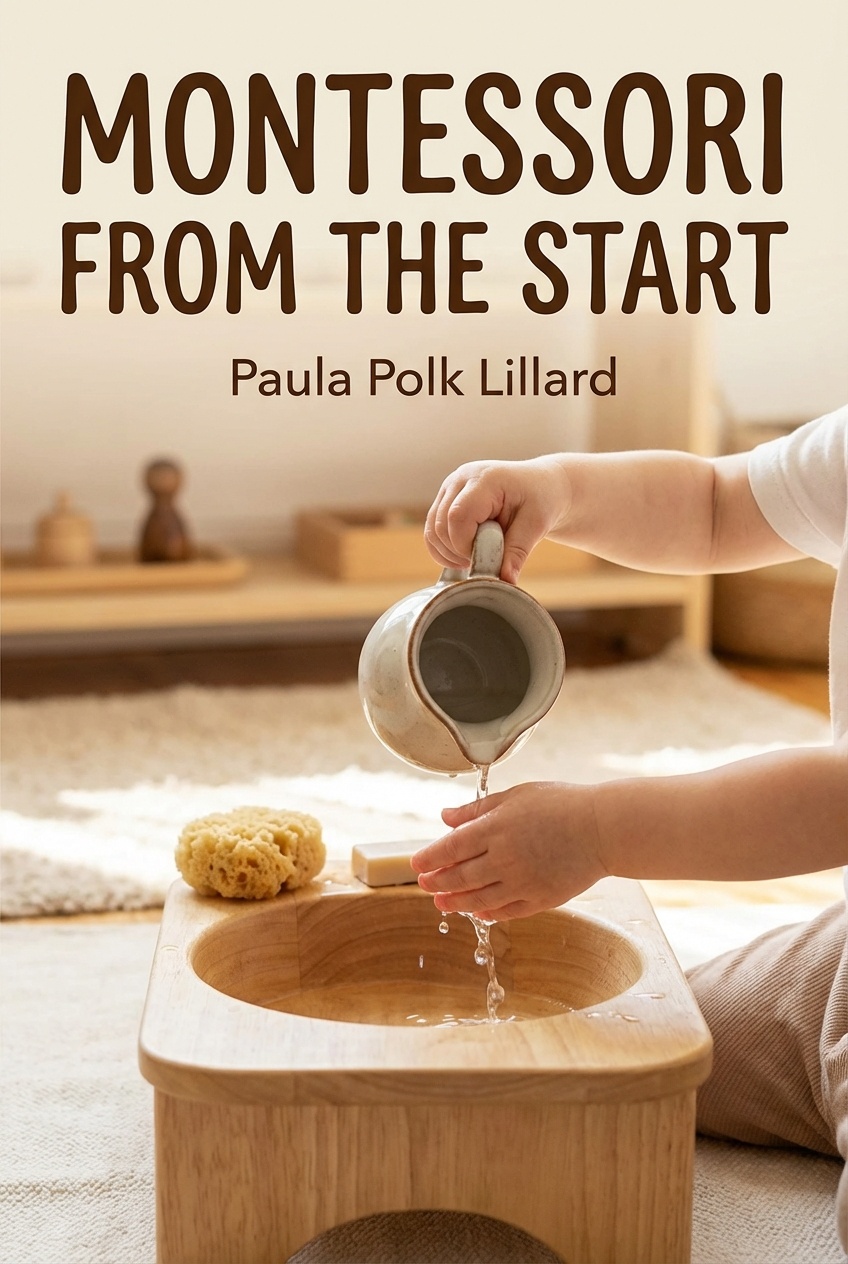
Toddlers have a strong desire to belong to their family unit and contribute to the household. Inviting them to participate in food preparation and cleaning fulfills this need. With the right setup, a toddler can wash vegetables, peel bananas, spread butter, sweep the floor, and wipe up spills. The key is to provide real, functional, child-sized tools, like a small glass pitcher, a real but dull knife, and a child-sized broom. In one book story, a young toddler was learning to pour water using a small, heavy glass pitcher and a real glass. Initially, the child spilled water everywhere. Instead of taking the pitcher away, the adult calmly provided a small sponge for the child to wipe up the spill. Through repeated practice, the child eventually mastered the coordination required to pour the water perfectly, beaming with pride at their newfound ability to serve themselves.
In the Montessori philosophy, toilet training is viewed as a natural biological process of learning bodily awareness, not a battle of wills or a system of rewards and punishments. It begins long before the child actually uses the toilet, starting with changing diapers in the bathroom so the child associates elimination with that specific room. As the child begins to walk, parents transition them to stand-up diaper changes and eventually to cotton training pants, which allow the child to feel the sensation of being wet. The adult's role is to observe the child's natural timing, offer the potty at regular intervals without pressure, and treat accidents neutrally as learning opportunities rather than failures.
A common misconception about Montessori is that children are allowed to do whatever they want. In reality, freedom in a Montessori environment is always coupled with responsibility and clear limits. Children are given the freedom to choose their activities, move around, and work at their own pace, but this freedom exists within a carefully structured framework. The limits are based on respect for oneself, respect for others, and respect for the environment. If a child throws a toy or hurts another person, the adult steps in immediately to enforce the limit. This balance ensures that the child feels secure and understands the boundaries of acceptable behavior, which is essential for developing true self-discipline.
Nurturing the whole child means recognizing that a child's intellect, emotional well-being, and physical development are deeply intertwined. The Montessori approach emphasizes that true intelligence is built through interaction with reality, not through flashcards or screens. It focuses on helping the child develop a strong will and internal self-discipline, rather than relying on external obedience. To support this holistic development, parents must cultivate the skill of objective observation.
Language development begins at birth, and children absorb the language of their environment effortlessly. The Montessori method stresses the importance of speaking to infants and toddlers using rich, precise, and correct vocabulary, rather than baby talk. Intelligence is fostered by connecting language to real-world experiences. When a child touches rough tree bark, the adult provides the word rough. Reading high-quality, realistic books about the actual world, rather than fantasy, helps the young child make sense of their immediate environment. The brain builds its cognitive architecture by categorizing and naming the real things the child experiences through their senses.
In Montessori, a strong will is not seen as a negative trait to be broken, but as a vital component of a healthy personality. Self-discipline cannot be forced from the outside through punishments and rewards; it must be developed from the inside out. This happens when a child is allowed to make choices, concentrate deeply on a chosen task, and experience the natural consequences of their actions. When a child is deeply engaged in purposeful work, whether it is scrubbing a table or building a tower, they are developing their ability to focus, persevere, and regulate their own impulses. The adult supports this by protecting the child's concentration and avoiding unnecessary interruptions.
Observation is the most critical tool in the Montessori parent's toolkit. It involves stepping back and watching your child objectively, like a scientist, without immediately jumping in to judge, correct, or help. By quietly observing, parents can discover what their child is genuinely interested in, what new skills they are trying to master, and what might be causing them frustration. This practice prevents parents from making assumptions based on their own adult agendas. Regular observation allows the parent to adjust the environment, rotate toys, and offer the right support at the exact moment the child is developmentally ready for it.
The ultimate role of the Montessori parent is to be a facilitator of the child's independence. This requires a profound respect for the child as a unique individual with their own developmental timeline. It means letting go of the ego-driven desire to have a child who performs tricks or hits milestones early to impress others. The parent must provide a rich, prepared environment, set clear and loving limits, and then have the courage to step out of the way. By trusting the child's innate drive to grow and learn, parents can transform their relationship from one of control and conflict to one of mutual respect and joyful discovery.
Hear the key concepts from this book as an engaging audio conversation.
Listen to Podcast