
Why You should Read This Book?
This book reveals how truly effective leaders build a "Circle of Safety" around their teams, creating an environment of trust and cooperation where everyone thrives. It explains that by putting their people first and demonstrating a willingness to "eat last," leaders foster loyalty, innovation, and a collective sense of purpose. Read it to learn how to cultivate a resilient, high-performing culture where employees feel secure, valued, and inspired to achieve greatness together.
Listen to PodcastDialogue turns nonfiction books into engaging podcast mini-series between two hosts, making key ideas easy to absorb on the go. It uses science-backed learning techniques to strengthen memory formation and complements the book's insights with supporting scientific evidence.
This theme explores the biological and anthropological roots of human cooperation. It posits that human beings are social animals who are biologically wired to seek safety in numbers. When we feel safe amongst our own kind, our natural reaction is to trust and cooperate. However, when we feel threatened—not just by physical danger, but by internal politics, fear of layoffs, or humiliation—our survival instincts kick in, forcing us to act selfishly to protect ourselves. The core message is that the environment dictates performance; if you get the environment right, the natural result is trust and high performance.
The 'Circle of Safety' is a concept derived from early human history and military strategy. In ancient times, tribes had to band together to defend against external threats like predators or rival tribes. When the tribe felt safe inside their circle, they could sleep at night and trust that others were watching out for them. In the modern workplace, the 'predators' are competitors or market crashes. However, often the biggest threats are inside the organization: micromanagement, office politics, and fear of dismissal. When a 'Circle of Safety' is strong, employees feel protected by their leaders and colleagues. Consequently, they stop wasting energy protecting themselves from each other and channel that energy outward to seize opportunities and tackle external challenges.
A leader is not just a decision-maker; they are the gatekeeper of the Circle of Safety. Just as a parent dictates the tone of a household, a leader sets the emotional tone of the organization. If the leader acts defensively or aggressively, the Circle breaks, and paranoia sets in. The book uses the story of 'Johnny Bravo,' an A-10 pilot who flew his aircraft through impossible weather conditions to provide cover for troops on the ground. He didn't do it for a paycheck or medals; he did it because he knew the men on the ground would do the same for him. A leader's job is to provide that same 'air cover' for their employees—taking the heat and responsibility so the team can focus on their work without fear.
Trust is not an instruction; it is a feeling that emerges when we believe someone has our best interests at heart. You cannot simply tell people to 'trust each other.' Trust is the biological result of empathy—the ability to recognize and share the feelings of another. When leaders display empathy, asking 'Are you okay?' rather than just 'Is the work done?', the brain releases Oxytocin, which physically strengthens the bond between people. Without empathy, people are viewed as resources or gears in a machine, which dehumanizes the workforce and destroys any chance of genuine loyalty.
Sinek breaks down human motivation into four primary chemicals: Endorphins, Dopamine, Serotonin, and Oxytocin. These chemicals evolved to help us survive. The first two are 'selfish' chemicals designed to help us get things done individually. The second two are 'selfless' chemicals designed to help us build social bonds. Modern corporate culture often overdoses on the selfish chemicals while neglecting the selfless ones, leading to high-stress, low-trust environments. Understanding this biology helps leaders create a balanced culture that promotes long-term well-being over short-term highs.
Endorphins are designed to mask physical pain, often known as the 'runner's high,' allowing us to push through exhaustion. Dopamine is the chemical of progress and achievement; it gives us a hit of pleasure when we cross something off a to-do list or hit a target. While necessary for getting work done, these chemicals are highly addictive and short-lived. A culture that focuses solely on hitting numbers, getting bonuses, and 'crushing the competition' is a Dopamine-fueled culture. It creates high performers who are often selfish, as they are biologically incentivized to care only about their own wins.
Serotonin is the leadership chemical; it is the feeling of pride we get when others respect us or when we make those we care about proud. It reinforces the social hierarchy and encourages leaders to serve their followers to maintain status. Oxytocin is the chemical of love, friendship, and deep trust. It is released through physical contact (like a handshake) and acts of generosity. Unlike Dopamine, Oxytocin takes time to build but is long-lasting. It is what allows us to turn our backs on our colleagues, knowing they won't stab us. It inhibits addiction and boosts the immune system.
When the Circle of Safety is broken, the body releases Cortisol, the stress hormone. Biologically, Cortisol is designed to make us paranoid and alert to danger so we can survive a predator attack. It shuts down non-essential functions like the immune system and growth to prepare for 'fight or flight.' In a toxic workplace, people have a constant drip of Cortisol in their system due to anxiety about their boss or job security. This chronic stress literally damages their health and inhibits the release of Oxytocin, making empathy and trust biologically impossible.
Create a free account to read the remaining themes and key concepts from this book.
Create an accountThis theme deals with the psychological distance created by modern business practices. As organizations grow, leaders become physically and emotionally separated from the people they impact. This 'abstraction' makes it easier to make cruel decisions because the suffering of employees is reduced to numbers on a spreadsheet. The book argues that true leadership requires bridging this gap and confronting the messy, human reality of the people within the organization.
The human brain is not designed to empathize with abstract numbers; it empathizes with tangible people. When a leader sits in a tower and looks at a spreadsheet, laying off 1,000 people looks like a smart financial move to 'save resources.' However, if that leader had to fire each person face-to-face and see their families, the decision would be much harder. Abstraction acts as a buffer that numbs our moral compass. The more distant a leader is from the front lines, the more likely they are to prioritize metrics over human lives.
Prioritizing numbers over people is a relatively new phenomenon in business history that leads to a toxic culture. When profit is the sole objective, people become disposable. The book shares the story of Bob Chapman, CEO of Barry-Wehmiller. During the 2008 recession, the company lost 30% of its orders. The board suggested layoffs. Chapman refused. Instead, he implemented a furlough program where everyone, from the CEO to the janitor, took four weeks of unpaid vacation. His reasoning: 'It is better that we should all suffer a little so that none of us has to suffer a lot.' The result was that morale soared, and employees even traded vacation time to help those who couldn't afford the pay cut. They felt safe, so they protected the company.
This section provides a historical critique of how the 'Greatest Generation' (who valued sacrifice and cooperation) gave way to the 'Baby Boomers' and the modern era of individualism. It highlights how the abundance of resources and the shift toward shareholder primacy in the 1980s altered the social contract between employer and employee. The focus shifted from 'stakeholder capitalism' (benefiting customers, employees, and the company) to 'shareholder capitalism' (maximizing short-term profit at all costs).
Destructive Abundance is the paradox where having more resources actually makes us value them less. When we have little, we treasure and protect what we have. When we have plenty, everything becomes disposable—including people. In the modern economy, employees are often treated like disposable razors: use them until they are dull, then throw them away and buy new ones. This commoditization of human beings erodes the Circle of Safety because no one feels valued for who they are, only for the immediate output they can produce.
Before the 1980s, it was common for companies to measure success in decades. However, changes in economic theories and the rise of high-frequency trading shifted the focus to quarterly earnings. Leaders are now incentivized to make decisions that look good on a balance sheet for the next three months, even if those decisions (like cutting R&D or training) hurt the company in the long run. This short-term focus forces leaders to extract value from their people rather than build value with them.
The final theme addresses the addictive nature of modern technology and corporate metrics. We have become a society addicted to the dopamine hits of likes, shares, and performance rankings. This addiction hinders our ability to form deep, oxytocin-based relationships. The book concludes by redefining leadership not as a rank or position, but as a choice to serve others and a commitment to the difficult, slow work of building trust.
There is a distinct difference between being a leader and being a person in authority. Authority is given by rank; people follow you because they have to. Leadership is a choice; people follow you because they want to. A person in authority can order people to work, but they cannot order people to care. True leaders may have no official title, but they are the ones who look out for those to the left and right of them. Conversely, many CEOs have authority but are not leaders because they view their people as tools for their own success.
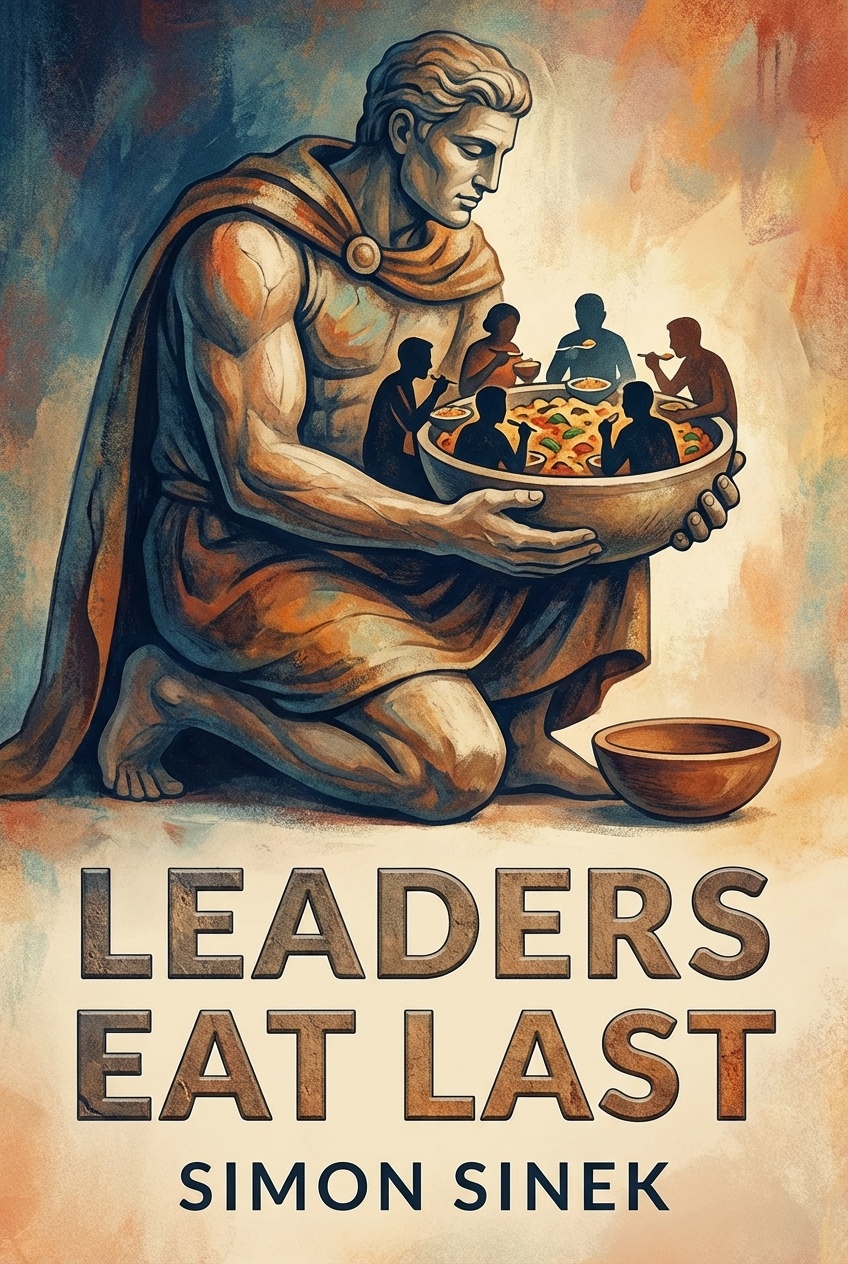
The title of the book comes from a tradition in the U.S. Marine Corps. When chow is served, the most junior Marines eat first, and the most senior officers eat last. No order is given; it is simply the culture. This is symbolic of a greater truth: true leaders are willing to sacrifice their own comfort and needs for the good of those in their care. In the business world, this means a leader is willing to sacrifice their bonus to save jobs, or give up their time to mentor a struggling employee. The price of leadership is self-interest.
Hear the key concepts from this book as an engaging audio conversation.
Listen to Podcast