
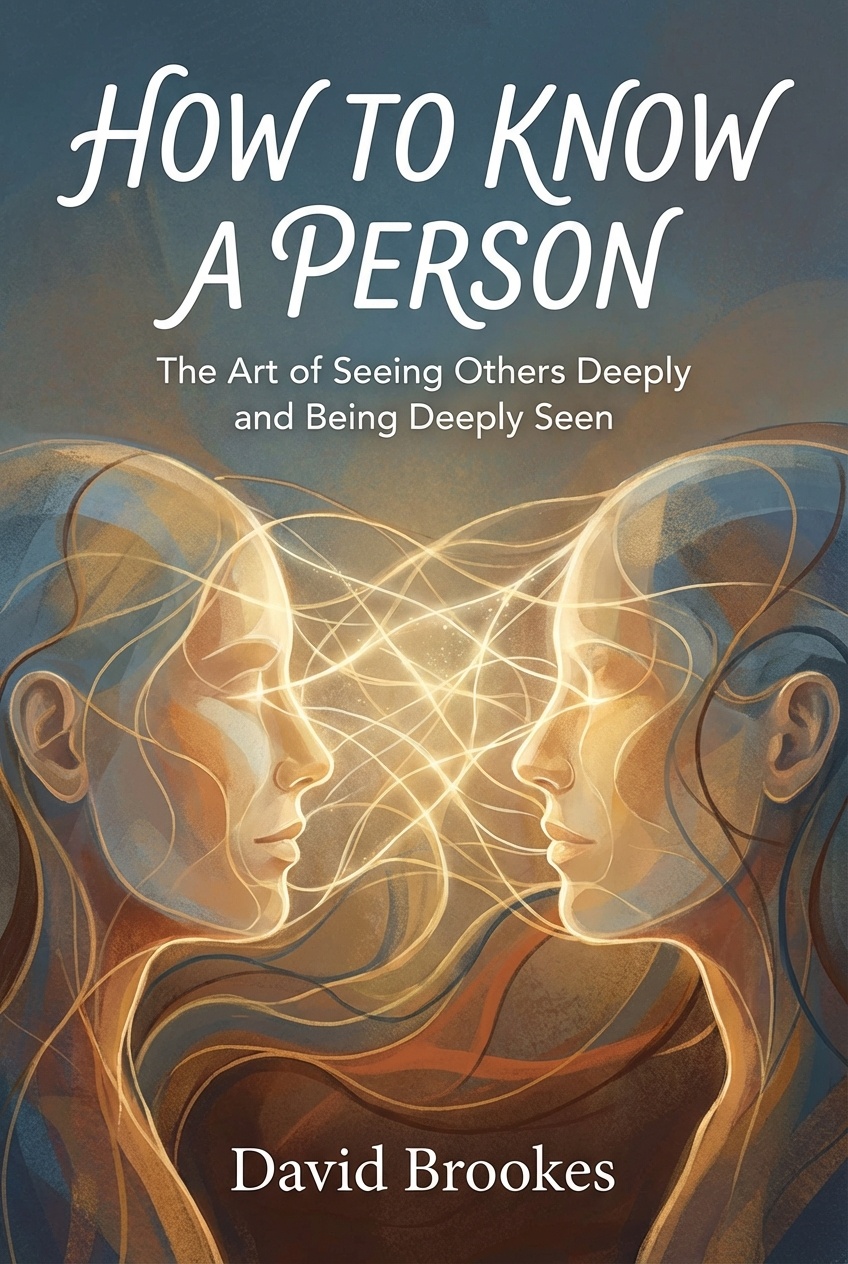
Why You should Read This Book?
This book offers a profound guide to genuinely understanding the people around you, moving beyond superficial interactions to cultivate deeper empathy and connection. It equips you with practical tools and a philosophical framework to truly see others, fostering richer, more meaningful relationships in every aspect of your life. Read it to transform how you perceive humanity and experience the profound satisfaction of being deeply seen yourself.
Listen to PodcastDialogue turns nonfiction books into engaging podcast mini-series between two hosts, making key ideas easy to absorb on the go. It uses science-backed learning techniques to strengthen memory formation and complements the book's insights with supporting scientific evidence.
This theme explores the fundamental shift required to truly connect with other human beings. It argues that seeing others is not a passive observation but an active, creative, and moral skill that must be developed. It contrasts the common habit of being self-centered with the transformative power of being deeply curious about those around us.
Many people live life armored up, focusing on their own competence and achievements while remaining emotionally distant from others. This concept describes the shift from being a 'knower'—someone who relies on facts and intellectual superiority—to being a 'seer,' someone who prioritizes emotional openness and connection. It involves realizing that professional success cannot compensate for the lack of deep human bonds. The journey requires unlearning the habit of keeping people at arm's length and instead embracing vulnerability to let others in.
The book categorizes people into two types based on how they interact with others. 'Diminishers' are so self-focused that they make people feel invisible; they check their phones, look over your shoulder for someone more important, and steer conversations back to themselves. 'Illuminators,' on the other hand, have a persistent curiosity about others. They shine a light on people, making them feel bigger, deeper, and respected. \n\n**Book Story:** The author shares a famous historical anecdote to illustrate this. A young woman named Jennie Jerome once dined with two great British leaders, William Gladstone and Benjamin Disraeli, on consecutive nights. After dining with Gladstone, she felt *he* was the cleverest person in England. But after dining with Disraeli, she felt *she* was the cleverest person in England. Gladstone was a genius, but Disraeli was an Illuminator who made her shine.
Seeing someone deeply is presented not just as a social skill, but as a moral duty. When people feel unseen, they feel dehumanized, which leads to loneliness and social fragmentation. Conversely, the act of truly beholding someone—looking at them with respect and reverence—validates their existence. It is a way of saying, 'You are valuable and you matter.' This gaze creates a sense of safety that allows the other person to blossom and reveal their true self.
We often think of attention as a spotlight that simply reveals what is already there, but this concept argues that attention is actually a creative force. How you look at someone influences who they become in that moment. If you look at someone with judgment, they will become defensive and rigid. If you look at them with warmth and expectation, they will often rise to meet that gaze, showing you their best qualities. You are actively constructing the social reality between you and the other person through the quality of your attention.
This theme moves from the mindset of connection to the specific mechanics. It breaks down the 'art' of being with people into actionable skills, focusing on how we listen, how we ask questions, and how we spend time together.
Accompaniment is the art of being present with others in a way that is loose and undemanding. It isn't about intense, face-to-face interrogation or deep therapy sessions. Instead, it is about 'lingering' with people—running errands together, playing sports, or just sitting side-by-side. It is a relaxed state of awareness where you are available to the other person without trying to lead or control the interaction. It is the practice of saying, 'I am here with you,' through your physical presence in ordinary moments.
Most people think listening is a passive act of staying quiet, but 'loud listening' is highly active. It involves burning calories to show the other person you are fully engaged. This means using physical cues like nodding, leaning in, and making sounds of agreement ('uh-huh', 'yes'). It also involves 'looping,' where you paraphrase what the person just said to ensure you understood it correctly. \n\n**Book Story:** The author cites the novelist E.M. Forster as a master of this. A biographer noted that Forster possessed an 'inverse charisma.' He didn't dominate the room; instead, he listened with such intensity and focus that the person talking to him felt compelled to be their sharpest, most honest, and best self. His listening actually changed the quality of the speaker's thoughts.
Standard social scripts rely on boring, factual questions like 'What do you do?' or 'Where are you from?' These lead to resume-reciting, not connection. To know a person, you must ask questions that invite them to tell a story or reflect on their values. Good questions focus on the *process* of their life, not just the result. They ask 'how' and 'why' rather than 'what.' They invite the person to step out of their daily autopilot and examine their own life narrative.
This concept attacks the modern plague of 'continuous partial attention.' You cannot know a person if you are glancing at your phone or scanning the room. True presence requires treating attention as an on/off switch, not a dimmer. When you are with someone, you must be 100% with them. This total focus signals respect and creates a container where trust can form. It involves suppressing your own ego and the urge to interrupt with your own stories.
Create a free account to read the remaining themes and key concepts from this book.
Create an accountThis theme addresses the harder aspects of human connection: dealing with loneliness, bridging deep disagreements, and sitting with people who are in pain. It offers a guide for how to be a steady presence when things are difficult.
Society is suffering from an epidemic of blindness where people feel invisible and misunderstood. This lack of connection leads to a 'mean world syndrome,' where lonely people become hyper-vigilant and suspicious of others. When people feel unsafe and unseen, they lash out. The antidote to this societal anger is not more debate, but more personal recognition. By making others feel safe and seen, we can de-escalate hostility and rebuild trust one interaction at a time.
When discussing difficult or divisive topics, the goal should not be to win the argument but to understand the other person's perspective. This requires creating 'safety' first. If the other person feels attacked, they will shut down. You must separate the person from the opinion. By asking questions about *how* they came to their beliefs—their personal experiences and stories—you can find common humanity even amidst deep disagreement.
When a friend is suffering or depressed, our instinct is often to try to 'fix' it with advice or cheerleading. This is usually unhelpful and can make the person feel more isolated. The correct approach is simply to be a witness. You cannot take away their pain, but you can ensure they don't have to face it alone. It is about offering a steady, non-judgmental presence that says, 'I am not going anywhere.'
Empathy is not just a soft feeling; it is a rigorous skill of 'mentalizing.' It involves using your imagination to construct a model of what the other person is experiencing. It requires getting out of your own shoes and realizing that the other person's reality might be completely different from yours. It involves understanding how suffering has shaped their worldview and respecting the scars they carry.
The final theme provides frameworks for understanding the complexity of human personality. It moves beyond surface traits to look at the deeper 'wiring,' life stages, and narratives that make each person unique.
To truly know someone, you must understand their wiring. The 'Big Five' model (Openness, Conscientiousness, Extroversion, Agreeableness, and Neuroticism) offers a reliable framework. These aren't just labels; they are descriptions of how a person's brain processes the world. For example, a high-neuroticism person perceives threats more acutely, while a high-openness person craves novelty. Understanding these traits helps you interpret behavior not as a personal slight, but as a reflection of their natural energy.
People are different depending on what 'life task' they are currently solving. A young adult might be focused on 'identity definition' (Who am I?), while a middle-aged person might be focused on 'generativity' (What is my legacy?). Knowing a person means understanding the specific struggle or chapter they are currently in. You cannot judge a person in their 20s by the standards of someone in their 50s.
We are the stories we tell ourselves. A person's identity is constructed through their narrative—is it a tragedy, a redemption story, or an overcoming-the-odds saga? To know a person, you must hear their story in their own words. You need to understand how they interpret their past and how they envision their future. The facts of their life matter less than the meaning they attach to them.
No one exists in a vacuum. We are all shaped by the cultures, histories, and traumas of our ancestors. Understanding a person involves seeing them as part of a long line of influences. This includes their family culture, their national history, and the collective experiences of their group. These invisible forces shape their values, their fears, and their definitions of success.
The book redefines wisdom not as knowing the most facts, but as being the most receptive. A wise person is one who can take in the full reality of another human being without distortion. It requires patience, humility, and the ability to sit with uncertainty. Wisdom is the result of a lifetime of truly seeing others, allowing their diverse experiences to expand your own understanding of life.
Hear the key concepts from this book as an engaging audio conversation.
Listen to Podcast