
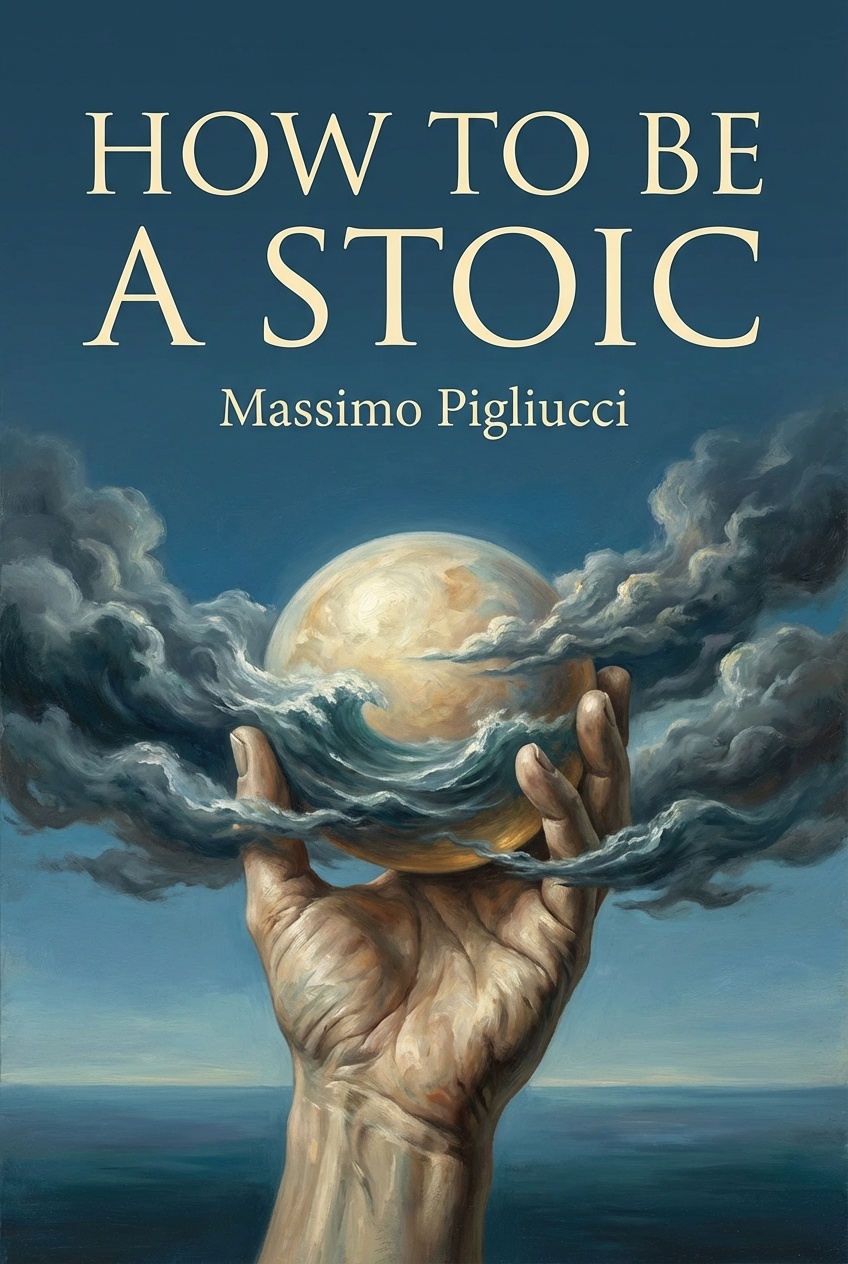
Why You should Read This Book?
This book offers a clear, modern guide to Stoicism, making an ancient philosophy accessible and practical for contemporary life. You'll learn actionable techniques to manage emotions, develop resilience, and find tranquility amidst life's challenges. Read it to cultivate a more rational, virtuous, and ultimately happier existence by applying time-tested wisdom to your everyday decisions.
Listen to PodcastDialogue turns nonfiction books into engaging podcast mini-series between two hosts, making key ideas easy to absorb on the go. It uses science-backed learning techniques to strengthen memory formation and complements the book's insights with supporting scientific evidence.
This section lays the groundwork for understanding Stoicism not as a dry academic subject, but as a vibrant, essential toolkit for navigating the complexities of modern existence. It redefines the philosophy away from the misconception of being emotionless and toward the pursuit of a meaningful, flourishing life.
Many people mistakenly believe Stoicism is about suppressing emotions and acting like a stone statue, similar to the character Spock from Star Trek. However, the book explains that Stoicism is actually a practical 'operating system' for life. It is designed to help us make better decisions, manage anger and anxiety, and find meaning in a chaotic world. It is less about complex theory and more about daily practice, offering a concrete roadmap for how to handle everything from minor annoyances to major life tragedies.
The author structures the Stoic curriculum around three distinct disciplines derived from the teachings of Epictetus. The Discipline of Desire teaches us what we should seek and what we should avoid, helping us accept what happens to us. The Discipline of Action guides how we behave toward others and how we handle our social duties. Finally, the Discipline of Assent focuses on our cognition, teaching us how to judge our initial impressions of the world so we don't get swept away by false beliefs or destructive emotions.
The ultimate objective of a Stoic life is 'eudaimonia.' While often translated as 'happiness,' a better translation is 'flourishing.' Happiness is a fleeting emotion that comes and goes, but flourishing is a state of being that comes from living a life of virtue and reason. It means living in a way that is worth living, regardless of whether you are currently feeling pleasure or pain. It is the deep satisfaction of knowing you are living up to your potential as a human being.
This theme explores the foundational Stoic skill of reorienting our desires. It focuses on understanding the limits of our power and learning to accept the natural order of the universe to avoid frustration and anxiety.
This is the most famous and critical concept in Stoicism. We must divide the world into two categories: things we control and things we do not. We have complete control over our own opinions, judgments, values, and decisions. We have absolutely no control over external things like the weather, the economy, our reputation, or even our own health (which can be taken by accident or disease). Suffering occurs when we pin our happiness on things outside our control.
When Stoics say 'live according to nature,' they don't mean running into the woods and hugging trees. They mean living according to *human* nature. The book defines human nature by two main characteristics: we are social animals, and we are capable of reason. Therefore, to live a good life, we must apply reason to our problems and work to improve society. If we act irrationally or antisocially, we are acting against our own nature, which leads to inner conflict and unhappiness.
Stoics believe that the only true 'good' is virtue (good character) and the only true 'bad' is vice (bad character). Everything else—money, health, status—is 'indifferent.' However, Stoicism is not a cult of poverty. These things are classified as 'preferred indifferents' (it is better to be healthy and rich than sick and poor) or 'dispreferred indifferents.' You can pursue preferred things, but you must realize they do not make you a better person, and you must be ready to give them up without a tantrum if fortune takes them away.
The Stoics viewed the universe as a rational, living organism governed by cause and effect, often called God or the Logos. Whether you believe in a divine plan or just scientific cause-and-effect (atoms bumping into atoms), the result is the same: the universe does what it does, and fighting against reality is futile. The book shares the story of a dog tied to a moving cart. The dog can either run along with the cart (acceptance) or be dragged by the neck (resistance). The cart moves either way; our choice is only in how we experience the journey.
Create a free account to read the remaining themes and key concepts from this book.
Create an accountMoving from internal desires to external behavior, this theme covers how a Stoic interacts with the world. It emphasizes that while we cannot control outcomes, we are obligated to act virtuously and fulfill our duties to others.
In Stoicism, your character is the only possession that cannot be taken away from you by fire, theft, or tyranny. It is the fortress of the soul. The book argues that we should prioritize the cultivation of character above all else because it is the source of all our decisions. If your character is flawed, your life will be flawed, no matter how rich or famous you become.
The Stoic moral compass is composed of four cardinal virtues. 'Wisdom' is the ability to navigate complex situations logically. 'Courage' is not just physical bravery, but the moral strength to stand up for what is right. 'Justice' is the practice of treating others fairly and with benevolence. 'Temperance' is the exercise of self-control and moderation in all things. Every action we take should be measured against these four standards.
Stoics view humanity as a single organism. 'Oikeiosis' is the process of 'appropriating' others into our concern. Imagine a set of concentric circles: the center is you, the next is your family, then friends, then fellow citizens, and finally all of humanity. The Stoic goal is to 'contract the circles,' pulling people from the outer rings closer to the center, treating a stranger with the same basic respect and care you would offer a cousin.
Developing virtue is hard, so Stoics recommend using role models as a shortcut. By observing someone who embodies the virtues you admire, you have a concrete template to follow. The book suggests keeping a mental 'board of directors'—whether real people, historical figures like Cato, or fictional characters—whom you can mentally consult when you are unsure how to act.
This theme deals with the mind's ability to process information. It focuses on the critical gap between perceiving an event and judging it, teaching us how to avoid automatic emotional reactions that lead to suffering.
We often think that an event (like an insult) automatically causes an emotion (like anger). Stoicism teaches that there is a middle step: the 'impression' (our judgment of the event). If someone calls you a name, that is just sound waves hitting your ear. You only feel anger if you judge those sound waves to be 'bad.' The Discipline of Assent is the practice of stopping that automatic judgment and testing it before accepting it as truth.
Stoics distinguish between 'proto-passions' (involuntary reflexes like jumping at a loud noise) and full-blown unhealthy emotions (like simmering rage or paralyzing fear). While we cannot stop the reflex, we can stop the cognitive process that turns a reflex into a mood. By changing the belief that fuels the emotion (e.g., changing 'I have been wronged' to 'He is mistaken'), we can dissipate the negative emotion.
The book teaches that insults only hurt us if we agree with them. If an insult is true, it is a chance to improve. If it is false, the insulter is mistaken, like someone who thinks it is night when it is day—they are the one suffering from a lack of knowledge, not you. Therefore, the proper response to an insult is not anger, but pity or humor.
This is a mental exercise where you visualize things going wrong before they happen. By imagining losing your job, getting sick, or facing a rude person, you mentally prepare yourself. This robs the future event of its shock value. When the bad thing happens, you are calm because you have already 'been there' in your mind. If it doesn't happen, you appreciate your safety even more.
The final section consolidates the philosophy into concrete daily rituals. These exercises are designed to keep the Stoic principles fresh in the mind and ensure they are applied consistently.
Stoics practice acknowledging that everything we love is temporary. This sounds morbid, but it is actually life-affirming. By realizing that your loved ones, your possessions, and your own life could end at any moment, you stop taking them for granted. It infuses the present moment with intense value and gratitude.
Whenever a Stoic makes a plan, they add a mental disclaimer: 'I will do this, fate permitting.' The book uses the story of the Archer to explain this. An archer can do everything right—choose the best bow, aim perfectly, and release smoothly—but a sudden gust of wind can still blow the arrow off course. The archer controls the shooting, not the hitting. By adding the reserve clause, we focus on our effort (the shooting) and accept that the result (the hitting) is not fully up to us.
Stoic mindfulness (Prosoche) is the practice of constant attention to your ruling faculty. It is about being fully present and aware of your moral choices in real-time. This is often paired with an evening journal routine where you review the day's events, analyzing where you acted with virtue and where you fell short, not to beat yourself up, but to learn.
A Stoic looks at a difficult situation the way an athlete looks at heavy weights in the gym: as necessary resistance for building strength. A rude waiter is not an annoyance; he is a training partner for your patience. A financial loss is not a tragedy; it is a training ground for your resilience. This reframing turns every negative event into a positive opportunity for growth.
Hear the key concepts from this book as an engaging audio conversation.
Listen to Podcast