
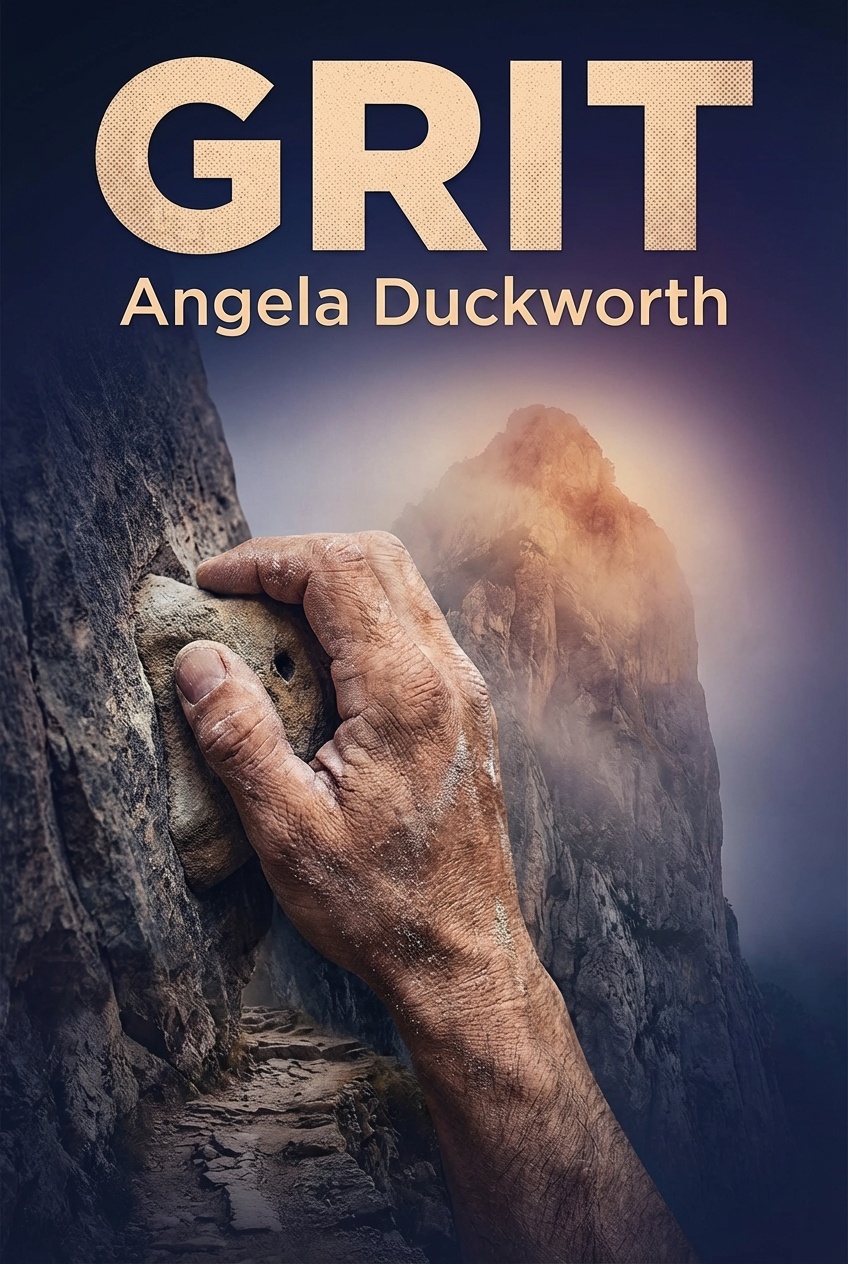
Why You should Read This Book?
This book reveals that sustained passion and perseverance—what Angela Duckworth calls grit—are the true predictors of success, often more so than talent. It provides compelling research and real-world examples demonstrating how anyone can cultivate this crucial trait. Read it to unlock practical strategies for building your own grit and achieving your most ambitious goals.
Listen to PodcastDialogue turns nonfiction books into engaging podcast mini-series between two hosts, making key ideas easy to absorb on the go. It uses science-backed learning techniques to strengthen memory formation and complements the book's insights with supporting scientific evidence.
This theme establishes the foundational definition of grit, distinguishing it from mere talent or luck. It explores the psychological makeup of high achievers and introduces the tools used to quantify this trait.
Grit is not just about working incredibly hard; it is about working hard on the same thing for a very long time. It combines 'passion,' which in this context means a deep, enduring commitment to a specific direction, with 'perseverance,' which is the resilience to bounce back from failure. While many people work with intensity for short periods, gritty people maintain their effort and interest over years, treating life like a marathon rather than a sprint. Think of grit as having an 'ultimate concern'—a compass that guides all other actions. It is the ability to say 'no' to good opportunities so you can say 'yes' to the one thing that matters most to you. It is holding the same top-level goal for a long time and staying loyal to it, even when progress is slow, boring, or difficult.
To study grit scientifically, a measurement tool was needed. The Grit Scale is a simple questionnaire that asks individuals to rate themselves on statements regarding their ability to maintain focus and effort over time. It asks questions like whether setbacks discourage you or if your interests change from year to year. The results yield a 'Grit Score' that has been found to be distinct from IQ or natural talent. **Book Story:** At the United States Military Academy at West Point, there is an intense seven-week training program called 'Beast Barracks.' It is physically and mentally grueling. For years, the Army tried to predict who would drop out using a 'Whole Candidate Score' (a mix of SAT scores, high school rank, and physical fitness). It didn't work well. However, when candidates took the Grit Scale, it turned out to be an incredibly accurate predictor. The candidates with the highest grit scores were the ones who survived Beast Barracks, regardless of their SAT scores or athletic ability.
The predictive power of grit extends far beyond the military. Research shows that in environments where challenges are high and talent is abundant, grit becomes the deciding factor. In sales, gritty employees sell more. In spelling bees, gritty kids study longer and rank higher. In education, gritty students achieve higher degrees. The common thread is that when things get easy, talent might give you a head start. But when things get difficult—when you hit a plateau or face rejection—talent often quits because it isn't used to struggling. Grit is the factor that keeps you moving forward when the novelty wears off and the real work begins.
This theme breaks down the mathematical relationship between natural ability and actual success. It challenges the societal obsession with 'naturals' and introduces a formula that proves effort is twice as important as talent.
It is important to define 'talent' strictly: it is merely the rate at which you get better when you put in effort. If you and a friend both practice piano for one hour, and your friend improves twice as much as you, they have more talent. However, talent alone is not achievement. Achievement is what happens when you take that developed skill and put it to use. Many people stop at talent. They rely on their quick learning speed but never put in the sustained effort to master the skill or apply it. This leads to the 'fragile overachiever'—someone who is used to things coming easily and crumbles the moment they have to work hard for progress.
This is the central equation of the book: Talent x Effort = Skill, and then Skill x Effort = Achievement. Notice that 'Effort' appears in both equations. First, you need effort to turn your raw potential (talent) into a usable ability (skill). But having the skill isn't enough. You must apply effort again to use that skill to produce results (achievement). Because effort figures into the equation twice, it has a multiplicative effect on the final outcome. A person with half the talent but twice the effort can drastically outperform a lazy genius. Without effort, talent is nothing more than unmet potential. With effort, talent becomes skill, and skill becomes achievement.
Despite what we say about valuing hard work, psychological studies show that people secretly prefer 'naturals.' We are more impressed by the musician who claims they 'never practice' than the one who admits to grinding for hours. This is the 'naturalness bias.' We view high achievement as magical and god-given because it excuses us from having to try that hard ourselves. By mystifying talent, we let ourselves off the hook. If success is due to a magical gift we don't have, we don't need to feel bad about not achieving it. Acknowledging that success is mostly due to relentless, unsexy, boring effort forces us to admit that we could achieve more if we were willing to do the work.
Create a free account to read the remaining themes and key concepts from this book.
Create an accountThis theme explains how gritty people organize their lives. It moves beyond simple 'to-do lists' to discuss goal hierarchies and the importance of aligning daily actions with a supreme, overarching purpose.
Gritty people don't just have 'goals'; they have a goal structure. Imagine a pyramid. At the bottom are short-term tasks (e.g., 'send email'). These support mid-level goals (e.g., 'finish project'). All of these point upward to a single, top-level goal (e.g., 'become a leading architect'). This top goal is the 'ultimate concern'—it is the end in itself. In this hierarchy, the low-level goals are just means to an end. If a low-level goal fails or isn't working, a gritty person is flexible and will swap it out for a different tactic. However, they are incredibly stubborn about the top-level goal. They are flexible on the 'how,' but unyielding on the 'why.'
When we hear the word 'passion,' we think of fireworks and intense emotion. In the context of grit, passion means 'consistency.' It is waking up and thinking about the same questions you thought about yesterday and the year before. It is moving in a constant direction, even if your daily progress is microscopic. Many people are 'enthusiastic' but not 'passionate.' They jump from hobby to hobby, starting with high energy and quitting when the learning curve gets steep. True passion is boring to watch because it looks like doing the same thing every day for years.
The good news is that grit is not a fixed genetic trait. Data shows that grit scores tend to go up as we age. This is called the 'maturity principle.' As we get older, we learn that losing our temper or quitting doesn't work. We develop a sense of responsibility and capability. However, you don't have to wait to get old to get gritty. You can accelerate this process by intentionally putting yourself in situations that require discipline and by adopting the mindsets of gritty people. You can 'grow' your grit from the inside out (changing your mindset) and from the outside in (changing your environment).
This theme introduces the four specific mental assets that gritty people possess. These assets usually develop in a specific order: Interest, Practice, Purpose, and Hope.
Grit isn't magic; it's built on four specific pillars. First comes **Interest** (you must enjoy the topic). Second is **Practice** (you must want to get better at it). Third is **Purpose** (you must believe it matters to others). Fourth is **Hope** (you must believe you can keep going despite setbacks). These assets tend to develop in this order. You can't practice effectively if you aren't interested, and you can't find deep purpose before you've mastered the skills through practice. Hope, however, is the rising tide that supports all three stages—you need hope at the beginning, middle, and end.
This theme debunks the myth of 'love at first sight' regarding career passions. It explains that interests are fragile at first and require time, play, and experimentation to deepen into a true passion.
You cannot grit your way through something you hate. At the core of every gritty person is a genuine curiosity and enjoyment of their subject. This doesn't mean they enjoy every single aspect (even pro athletes hate early morning training), but they have a fundamental love for the game itself. This intrinsic drive is essential because it fuels the energy needed for the hard work that comes later. If you are forcing yourself to do something solely for money or status, your grit will run out when obstacles arise. You must be doing it for yourself first.
Hollywood tells us that we discover our passion in a sudden 'Aha!' moment. In reality, interests are triggered by interactions with the outside world and are often vague at first. A future botanist doesn't look at a flower and instantly know their destiny; they just think, 'That's kind of cool.' Passion is not discovered; it is deepened. It requires a period of 'discovery' where you try things out, followed by a period of 'development' where you learn more. If you expect to fall in love with a career instantly, you will quit too early. You have to stick around long enough for the nuance and complexity to capture your attention.
This theme distinguishes between 'naive practice' (just doing the thing) and 'deliberate practice' (systematic improvement). It explains how experts practice differently than amateurs.
After interest is established, the next stage is the desire to get better. This is where the grind begins. Gritty people don't just show up; they show up with the intent to improve. They are constantly looking for the gap between where they are and where they want to be. This is the difference between ten years of experience and one year of experience repeated ten times. A gritty person is never satisfied with their current level of skill. They have a healthy dissatisfaction that drives them to refine their craft every single day.
Experts practice differently. They use 'deliberate practice.' This involves four steps: 1) Set a clearly defined stretch goal (something you can't do yet). 2) Focus with full concentration and effort. 3) Seek immediate, informative feedback (usually negative). 4) Repeat with reflection and refinement. Most people enjoy doing what they are already good at. Gritty people intentionally seek out what they are bad at. They want to know what they are doing wrong so they can fix it. This process is often not 'fun' in the moment—it is draining and difficult—but it is the only way to achieve mastery.
This theme explores the shift from self-interest to other-interest. It explains how connecting your work to a larger cause creates a deeper, more sustainable form of motivation.
While interest is about 'me' (what I enjoy), purpose is about 'we' (how I help). Gritty people almost always view their work as a calling. They believe that what they do contributes to the well-being of others. This shift usually happens later in the journey, after the person has developed high skill. **Book Story:** There is a classic parable about three bricklayers. When asked what they are doing, the first says, 'I am laying bricks.' The second says, 'I am building a church.' The third says, 'I am building the house of God.' The first has a job (paycheck). The second has a career (advancement). The third has a calling (purpose). Gritty people are like the third bricklayer; they see the ultimate significance of their mundane actions.
You can start with just interest, but you can't finish with it. Eventually, the novelty wears off, or the work becomes too hard. If you are only doing it for your own amusement, it's easy to quit. But if you believe people are counting on you, you find a second wind. The most gritty individuals combine these two: they love the work (interest) AND they love who the work helps (purpose). This dual engine provides the most powerful fuel for long-term perseverance.
This theme defines hope not as a passive wish, but as an active cognitive habit. It connects grit to the concept of a 'Growth Mindset.'
In the context of grit, hope does not mean 'I hope tomorrow is sunny.' It means 'I have the power to make tomorrow better.' It is an active, cognitive type of hope. It is the expectation that your own efforts can improve your future. Gritty people explain setbacks optimistically. When they fail, they tell themselves it was due to a specific, temporary, and fixable cause (e.g., 'I didn't practice enough'). Less gritty people explain setbacks pessimistically, viewing them as permanent and pervasive (e.g., 'I'm just not good at this').
This concept comes from Carol Dweck's research. A 'fixed mindset' believes talent is static—you have it or you don't. A 'growth mindset' believes the brain is like a muscle that gets stronger with challenge. Gritty people possess a growth mindset. Because they believe they can change, they don't view failure as a diagnosis of their worth. They view it as data. This belief system is what allows them to get back up. If you believe you can't learn, there is no point in trying again. If you believe you can learn, trying again is the only logical step.
This theme provides a blueprint for raising gritty children (or managing employees). It advocates for a specific parenting style that balances high standards with warm support.
Psychologists map parenting on a grid. High demandingness/low support is 'Authoritarian.' Low demandingness/high support is 'Permissive.' Low/Low is 'Neglectful.' But High Demandingness AND High Support is 'Wise Parenting' (or Authoritative). To raise gritty kids, you must be a 'Wise Parent.' You must set incredibly high standards and expect your children to meet them, but you must also provide the warmth, love, and resources to help them get there. It is not about being a taskmaster; it is about being a supportive coach who believes the child is capable of more.
This is a practical rule for families. It has three parts: 1) Everyone (including parents) has to do a 'hard thing'—something that requires daily deliberate practice. 2) You can quit, but only at a natural stopping point (e.g., the end of the season or semester). You cannot quit on a bad day. 3) You get to pick your own hard thing. This rule teaches children that they have autonomy (they choose the activity), but they also have responsibility (they must honor their commitment). It prevents them from quitting just because things got difficult, teaching them the feeling of pushing through the 'dip' to the other side.
This theme moves beyond the individual to discuss how social groups, teams, and cultures influence grit. It argues that grit is contagious and can be absorbed from your surroundings.
Research shows that the best predictor of adult success isn't just grades, but a 'Follow-Through' rating in extracurriculars. Kids who join a club and stick with it for multiple years, eventually taking on leadership roles, demonstrate grit. The 'playing fields of Eton' concept is real. Structured activities (sports, band, debate) provide a sandbox for grit. They have coaches, immediate feedback, and the requirement to practice. They teach the correlation between effort and improvement in a way that standard classroom learning often does not.
If you want to be grittier, join a gritty team. The drive to conform is powerful. If you join a group where everyone wakes up at 4:00 AM to train, you will eventually do it too, just to fit in. Over time, the behavior becomes a habit, and the habit becomes an identity. Leaders create this culture by having a clear, top-level vision and modeling the work ethic required to achieve it. They don't just talk about values; they demonstrate them. When the leader is the hardest worker in the room, the culture shifts toward grit.
Hear the key concepts from this book as an engaging audio conversation.
Listen to Podcast