
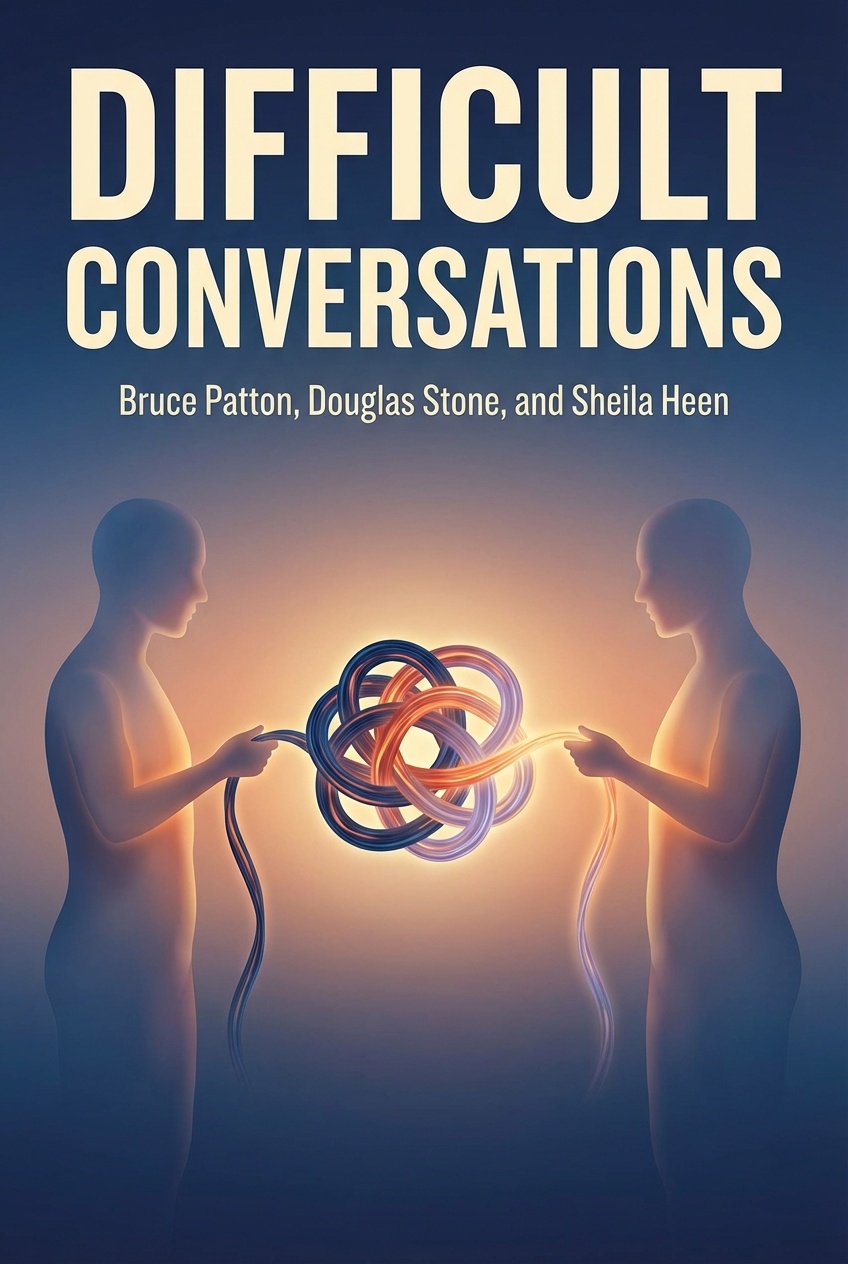
Why You should Read This Book?
This book dissects why difficult conversations often go wrong by revealing the three underlying conversations we're actually having, from "What Happened" to Identity. It provides a powerful framework and practical strategies to prepare for, initiate, and navigate these challenging interactions with greater clarity and confidence. By understanding its insights, you will transform your communication, fostering more productive outcomes and stronger relationships in every aspect of your life.
Listen to PodcastDialogue turns nonfiction books into engaging podcast mini-series between two hosts, making key ideas easy to absorb on the go. It uses science-backed learning techniques to strengthen memory formation and complements the book's insights with supporting scientific evidence.
Every difficult conversation is actually three conversations happening simultaneously. The first is the 'What Happened?' Conversation, which is about the disagreement over the facts, what should happen, and who is to blame. The second is the Feelings Conversation, which deals with the emotions involved and whether they are valid. The third is the Identity Conversation, an internal dialogue each person has about what the situation means for their sense of self. Understanding this three-level structure is the first step to managing challenging discussions more effectively, as our most common mistakes occur within these hidden layers.
The 'What Happened?' Conversation is where we spend most of our energy in a conflict, arguing about the facts of the situation. This conversation revolves around three core assumptions that create problems: the 'truth' assumption, the 'intention' assumption, and the 'blame' assumption. We assume our version of events is the absolute truth, that we know the other person's intentions, and that the problem is solely their fault. These arguments are rarely productive because difficult conversations are not about getting the facts right; they are about conflicting perceptions, interpretations, and values. We each have different information, notice different things, and interpret events through our own unique life experiences. Instead of trying to prove we are right, the goal should be to understand how the other person sees the world and why their perspective makes sense to them.
Difficult conversations are, at their core, about feelings. Emotions are not just a noisy byproduct of the conflict; they are an integral part of it. We often try to keep feelings out of the discussion, believing they are irrelevant or will make things worse. However, unexpressed feelings don't disappear; they leak into the conversation through tone of voice, body language, and accusations, or they can burst out in unproductive ways. Attempting to have a difficult conversation without addressing the underlying emotions is like staging an opera without the music—you might get the plot, but you miss the entire point. The key is not to vent or suppress emotions, but to identify, understand, and describe them as part of the conversation, acknowledging their importance without judgment.
The Identity Conversation is the internal dialogue we have with ourselves about what the situation means to us. It's about our self-esteem, self-image, and sense of who we are in the world. This conversation can be the most challenging because it raises fundamental questions about our competence, our goodness, or our worthiness of love. For example, getting critical feedback from a boss might trigger the question, 'Am I incompetent?' An argument with a loved one might make us wonder, 'Am I unlovable?' When our identity feels threatened, we can lose our balance, become defensive, and find it difficult to engage in a productive conversation. A major factor that makes our identity vulnerable is 'all-or-nothing' thinking—the belief that we are either competent or incompetent, good or bad. This leaves our self-esteem unstable and hypersensitive to feedback.
To move from a battle of messages to a productive dialogue, you must shift your internal stance from one of certainty to one of curiosity. This means transforming a difficult conversation into a 'learning conversation.' The goal is no longer to persuade, win, or deliver a message, but to learn. You aim to understand the other person's perspective, to express your own views and feelings, and to work together on solving the problem. This shift requires deconstructing the 'What Happened?' conversation by challenging three core assumptions: the truth assumption, the intention assumption, and the blame assumption. Instead of arguing about who's right, you explore each other's stories. Instead of assuming their intentions, you separate their intent from the impact on you. And instead of assigning blame, you map how you both contributed to the situation.
The most common mistake in the 'What Happened?' conversation is arguing over who is right, which is a dead end. Difficult conversations are rarely about facts; they are about conflicting perceptions and interpretations. Each person's story is built from different information and past experiences, which leads them to different conclusions. Both stories can make sense and be valid simultaneously. Arguing prevents us from understanding the other person's world and why they see things the way they do. Progress only happens when people feel understood. The solution is to adopt the 'And Stance,' a mindset that allows you to hold multiple perspectives at once. You can believe your story is true *and* acknowledge that their story is also true from their perspective. This doesn't mean giving up your own view, but rather adding their perspective to your own to get a fuller picture.
A critical error we make is assuming we know the other person's intentions based on the impact their actions had on us. If we feel hurt, we assume they intended to hurt us. This is a flawed assumption because intentions are invisible and often complex. Accusing someone of bad intentions immediately puts them on the defensive, as they feel misjudged and unappreciated. They will likely argue that wasn't their intent, while you will argue about the impact it had on you, leading to a classic communication standoff. Furthermore, we tend to judge others by the negative impact they have on us, but we judge ourselves by our good intentions. We often don't see the negative impact our own actions have on others. The book tells a story of a man named Randy who is visiting his friend Leo, a cardiologist. When Leo gets an emergency call and has to leave, Randy feels slighted. Randy assumes Leo's intention was to brush him off, but Leo's intention was to save a patient's life. This highlights the gap between the impact on Randy (feeling unimportant) and Leo's actual intent.
The third major error in the 'What Happened?' conversation is focusing on blame. Blame is about judgment and punishment, looking backward to determine who is at fault. This approach is counterproductive because it triggers defensiveness, hides the true causes of the problem, and prevents learning. When people feel blamed, they spend their energy defending themselves instead of solving the problem. A more effective approach is to shift from a 'blame frame' to a 'contribution system.' Contribution is about understanding, not judgment. It looks forward and asks, 'How did we *each* contribute to this situation?' Contribution acknowledges that problems are often the result of a system where both parties have played a role. For example, a manager might complain that an employee never takes initiative. In a blame frame, the employee is lazy. In a contribution system, we might discover the manager micromanages, which discourages the employee from taking risks. Both contribute to the dynamic.
Create a free account to read the remaining themes and key concepts from this book.
Create an accountThe true difficulty in these conversations lies not just in what happened, but in the two deeper conversations: Feelings and Identity. To navigate a challenging discussion successfully, you must learn to manage your emotions and ground your identity. Feelings are the heart of the matter and must be addressed, not ignored. Similarly, your identity—your sense of who you are—is often at stake, and feeling threatened can destabilize you. By learning to handle these two internal conversations, you can remain balanced and constructive even when the conversation becomes heated. This involves understanding and expressing your feelings without blame and becoming aware of your identity triggers so you can manage them effectively.
Feelings are a non-negotiable part of difficult conversations; you cannot wish them away. When you try to suppress them, they inevitably find a way to express themselves, often in destructive ways like sarcasm, impatience, or accusations. The first step is to recognize that your feelings are just as important as the 'facts' of the situation. Before you can express them constructively, you must first understand them yourself. This requires digging beneath simple labels like 'anger' to uncover the more complex bundle of emotions underneath, which might include disappointment, hurt, or fear. Once you understand your feelings, you can describe them in a way that is clear and non-blaming. The goal is to share your emotional state as another piece of information in the conversation, not as a weapon to attack the other person. Acknowledging feelings—both yours and theirs—is a prerequisite for any meaningful problem-solving.
The Identity Conversation is the most subtle and often the most powerful force in a difficult conversation. It's the internal debate about what the situation says about you. Common identity questions that get triggered are: 'Am I competent?', 'Am I a good person?', and 'Am I worthy of love?' When we feel our identity is under attack, we experience an 'identity quake,' which can knock us off balance and make us feel overwhelmed, anxious, and defensive. This is often driven by 'all-or-nothing' thinking, where we believe we must be either perfect or a complete failure. For example, if a client is unhappy, a designer might think, 'This means I'm a terrible designer,' which is a direct threat to their identity as a competent professional. This internal panic makes it nearly impossible to listen or respond constructively. The key to managing this is to develop a more complex and resilient identity.
Once you have shifted your internal stance and managed your feelings and identity, the final step is to structure the conversation itself to be a learning experience for both parties. This involves being clear on your purpose, starting the conversation in a way that invites collaboration rather than conflict, and then engaging in a cycle of effective listening and clear expression. A learning conversation is not about delivering a message but about creating a dialogue where both people can share their stories, understand each other's perspectives, and work together to find a way forward. It requires a specific set of skills: starting with a neutral 'Third Story,' listening with genuine curiosity to understand the other person from the inside out, speaking for yourself with clarity and power, and taking the lead in problem-solving.
Before initiating a difficult conversation, you must first clarify your purpose. If your goal is to change the other person, prove a point, or punish them, the conversation is likely doomed to fail. These purposes are based on a flawed assumption that you can control someone else's reactions or beliefs. Instead, a productive purpose for a difficult conversation is threefold: to learn the other person's story, to express your own views and feelings, and to problem-solve together. This 'learning' purpose sets the stage for a constructive dialogue. Sometimes, after working through the three conversations internally, you may realize that a conversation isn't the best way to address the issue. For example, you might discover the conflict is more about an internal identity struggle than an interpersonal issue, or that you can change your own contribution to the system without needing to talk. In these cases, letting go is the wisest choice.
How you begin a difficult conversation is critical; starting from within your own story is almost guaranteed to provoke defensiveness. If you open with 'I'm upset about what you did,' the other person will likely feel attacked and immediately start preparing their rebuttal. The most effective way to begin is from the 'Third Story.' The Third Story is the perspective of a neutral, impartial observer. It describes the problem as a difference between your two perspectives, without judgment or bias. For example, instead of saying, 'You broke your promise to finish the report,' you could start with the Third Story: 'It seems we had different understandings about when the report was due. I was expecting it on Tuesday, and I know you thought it was due Thursday. I'd like to talk about how we can get on the same page.' This opening is neutral, acknowledges both viewpoints as legitimate, and invites the other person to join you in figuring things out together.
Effective listening is the single most important skill in a difficult conversation. People will not be open to changing or considering your perspective until they feel heard and understood. True listening is not about waiting for your turn to talk; it's about being genuinely curious and working to understand the other person's story from their point of view. This requires more than just silence; it involves active engagement. The key skills for good listening are inquiry, paraphrasing, and acknowledging feelings. Inquiry means asking open-ended questions to genuinely learn more about their perspective. Paraphrasing involves restating what you've heard in your own words to check your understanding and show them you're listening ('So, it sounds like you're feeling...'). Acknowledging their feelings means showing that you see their emotions as valid, even if you don't agree with their story or conclusions ('I can see why that would make you angry').
Once the other person feels heard, it's your turn to express yourself. Effective expression is not about delivering a devastating monologue or watering down your message to avoid conflict. It's about speaking for yourself with clarity and power, sharing what is most important to you without blame or judgment. Start by stating what matters most to you, rather than hinting or asking leading questions. Own your perspective by using 'I' statements and avoiding generalizations like 'always' or 'never.' Share the sources of your conclusions—the information you have and the experiences that have shaped your view. A crucial tool for clear expression is the 'And Stance.' Instead of saying, 'I know you had a tough week, *but* you still missed the deadline,' which negates the first part of the sentence, say, 'I know you had a tough week, *and* it's also true that the deadline was missed.' This allows you to express your full, complex reality without minimizing their experience.
After both parties have shared their stories and feel understood, you can move on to problem-solving. It's a mistake to jump to solutions too early, as any proposed solution will fail if it doesn't account for both people's perspectives and feelings. To begin problem-solving, you first need to gather information and test your perceptions, ensuring you have a full understanding of the issue from both sides. Then, you can work together to invent options that meet the core concerns of both people. This is a creative process of brainstorming, not a negotiation where one person has to lose. A book story illustrates this with a couple, Michael and Angela, arguing over a new car. Michael wants a safe sedan, while Angela wants a stylish convertible. Instead of fighting over car models (their positions), they explore their underlying interests. Michael's interest is safety for their future kids; Angela's is feeling fun and adventurous. By understanding these interests, they can brainstorm solutions that meet both needs, like a sporty but safe SUV or agreeing to rent a convertible for weekend trips.
Hear the key concepts from this book as an engaging audio conversation.
Listen to Podcast