
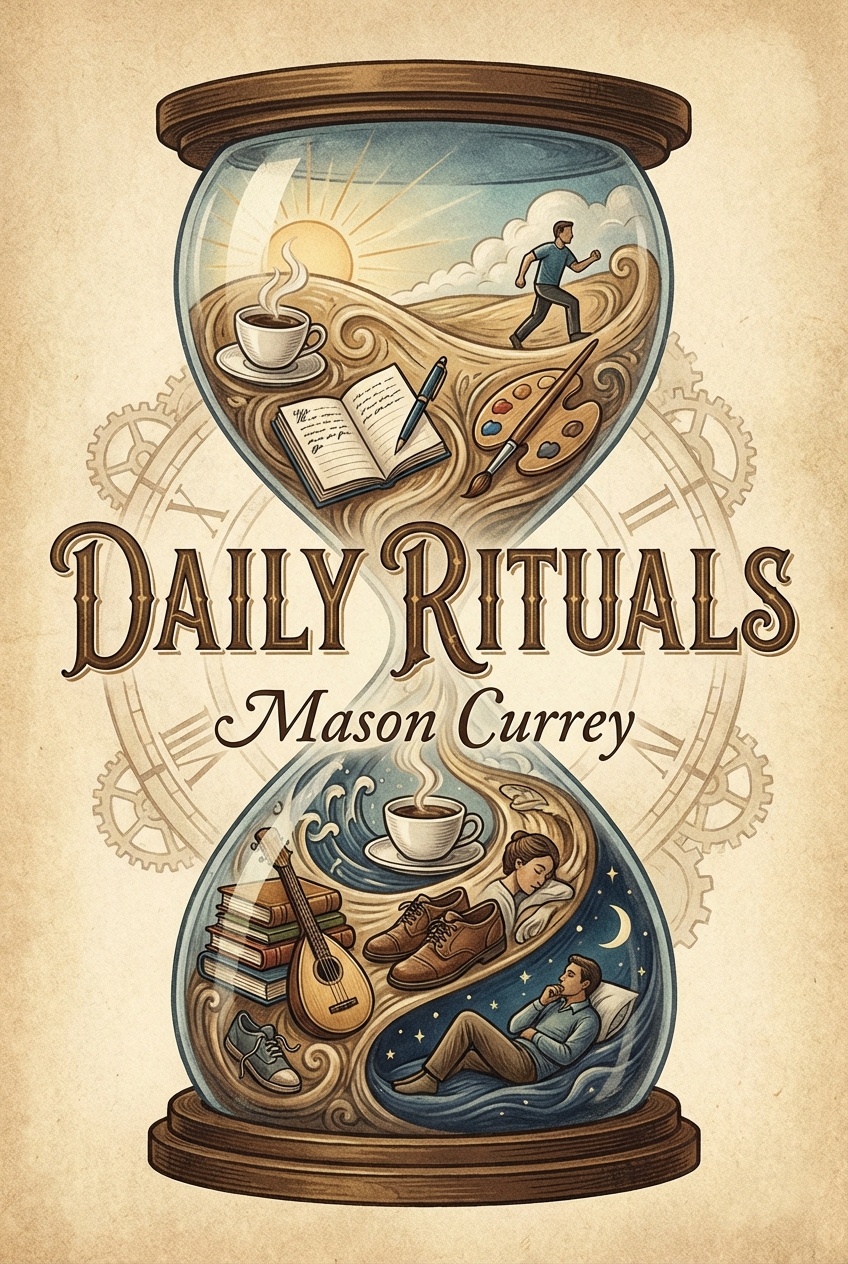
Why You should Read This Book?
This book offers a fascinating glimpse into the daily routines and eccentric habits of over 160 prolific artists, writers, and thinkers. It demystifies the creative process, revealing that genius often stems from consistent, sometimes peculiar, daily rituals rather than pure inspiration. Reading it will inspire you to examine your own routines, find what works best for your productivity, and cultivate habits that foster your unique creative potential.
Listen to PodcastDialogue turns nonfiction books into engaging podcast mini-series between two hosts, making key ideas easy to absorb on the go. It uses science-backed learning techniques to strengthen memory formation and complements the book's insights with supporting scientific evidence.
This theme explores why high achievers rely so heavily on repetitive daily structures. It is not about being boring or robotic; rather, it is about automating the basics of life to free up mental space for high-level thinking. By establishing a predictable rhythm, artists and thinkers protect themselves from the chaos of daily life and their own fluctuating moods.
The book illustrates that the most productive individuals do not wait for lightning to strike. Instead, they build a rigid scaffold for their day. By deciding in advance exactly when they will work, eat, and sleep, they remove the burden of choice. This consistency ensures that work happens automatically, regardless of how they feel when they wake up.
The author references the idea that a routine creates a 'well-worn groove' for one's mental energies to flow through. When you follow the same pattern daily, you don't have to expend willpower to get into the zone; your brain recognizes the pattern and switches into work mode naturally. This acts as a buffer against mood swings, ensuring that a bad mood doesn't derail a day's productivity.
Far from being a constraint, a strict routine is presented as a tool for disciplining passion. The book suggests that having a solid routine is actually a symptom of high ambition. It demonstrates a refusal to let the precious hours of the day be eaten up by trivialities. It is the practical application of a desire to create something lasting.
Every person has a limited amount of time, energy, and self-discipline. The book highlights how successful creatives use routine to guard these resources jealously. By regularizing their habits, they ensure that their best energy is spent on their work, not on figuring out what to have for lunch or when to do laundry.
This theme examines the logistics of how creative work actually gets done. It looks at the specific timing of work blocks, the debate between working early or late, and the reality of juggling creative passion with the need to earn a living.
A vast number of the figures in the book prioritize working early in the morning, often before dawn. The logic is that the mind is freshest after sleep, and the world is quietest. There are fewer phone calls, emails, and demands from others, allowing for a pure, uninterrupted connection to the work.
Deep, creative work cannot be done in five-minute increments between errands. The book emphasizes the necessity of carving out solid blocks of time—often three to four hours—where the creator is completely unreachable. This continuity allows for the deep focus required to solve complex problems or generate high-quality output.
While mornings are popular, the book makes it clear there is no single 'correct' time. Some artists are night owls who work best when the rest of the world is asleep. The key takeaway is not to copy someone else's clock, but to discover your own biological peak times and protect them fiercely.
Many famous creators did not have the luxury of full-time leisure; they had to squeeze art into the margins of a 9-to-5. A famous example from the book is Anthony Trollope, who worked as a postal surveyor. Every morning, he arrived at his desk at 5:30 AM. With his watch in front of him, he required himself to write 250 words every 15 minutes. If he finished a novel before his time was up, he would immediately take a fresh sheet of paper and start the next one. He did this for years, proving that consistency outweighs free time.
Create a free account to read the remaining themes and key concepts from this book.
Create an accountThis theme focuses on the physical spaces where work happens. It highlights that controlling one's environment is a way of controlling one's mind. Whether through isolation, specific furniture, or sensory deprivation, the goal is to create a space that triggers focus.
The book describes how many creators go to extreme lengths to remove visual and auditory distractions. This might mean facing a blank wall rather than a window, or working in a room with no books or art to capture the eye. The environment is engineered to make the work the most interesting thing in the room.
A recurring requirement for deep work is the absence of other people. Many subjects in the book required absolute privacy, unable to function if they knew someone was listening or watching. Solitude allows for the vulnerability and risk-taking necessary for creativity without the fear of judgment or interruption.
There is no 'perfect' office setup. Some creatives thrived in messy, chaotic studios that stimulated their senses, while others needed clinical sterility. The lesson is that the environment must match the psychological needs of the worker—some need stimulation, while others need a vacuum.
This theme looks at the physical and chemical inputs that creators use to keep going. It covers the widespread use of stimulants, the critical importance of physical movement, and the odd little rituals that serve as on-switches for the brain.
Chemical assistance is a major theme in the daily lives of many geniuses. Coffee is the most common tool, used not just for energy but as a ritualistic start to the day. The book details Ludwig van Beethoven's obsessive morning coffee ritual: he determined that his coffee should be made of exactly sixty beans per cup. He would often count them out one by one to ensure the dosage was precise. This wasn't just about the caffeine; the counting was a meditative act that prepared his mind for composition.
A surprising number of thinkers relied on long, daily walks to solve problems. They would work for a few hours, hit a wall, and then go for a walk to let their subconscious process the information. The physical rhythm of walking seems to help untangle complex mental knots.
The book is full of idiosyncratic behaviors, from lying down on the floor to working in a bathtub. These quirks aren't madness; they are sensory cues. By repeating a specific, sometimes odd action, the creator signals to their brain that they are entering a specific state of mind where the rules of normal life don't apply.
Managing energy isn't just about pushing hard; it's about recovery. Many routines included specific times for meals, naps, or leisure reading. These periods of relaxation were treated with as much seriousness as the work itself, because the creators understood that a tired brain produces poor work.
This theme reveals the often-overlooked social support systems behind famous individuals. It explores the role of spouses, the balance between socializing and isolation, and how domestic responsibilities were historically distributed.
The book implicitly reveals that many 'solitary geniuses' were actually heavily supported by spouses (historically, usually wives) who managed the household, cooked meals, screened visitors, and dealt with finances. This 'invisible labor' created the bubble of silence and stability the artist needed to work.
While solitude is needed for the work itself, social interaction is often the fuel for new ideas. Many routines included specific times for visiting cafes, hosting dinners, or writing letters to peers. These interactions provided a necessary release of tension and a source of intellectual cross-pollination.
The book highlights a historical disparity: male artists often had routines that were protected by others, whereas female artists often had to build their routines around the demands of childcare and housekeeping. This demonstrates that for many, the struggle was not just creative but logistical—fighting for the right to have time at all.
This theme addresses the psychology of the worker. It dispels the myth of the effortless genius and reveals the struggle, doubt, and sheer persistence required to produce anything of value. It emphasizes adaptability and the rejection of perfectionism.
The most common thread in the book is the rejection of 'inspiration.' The subjects did not wait to feel like working; they worked because it was time to work. They viewed their craft as a job that required attendance, believing that inspiration would only show up if they were already at the desk.
The book proves that what works for one person may destroy another. Some drank vodka for breakfast; others were teetotalers. Some worked 12 hours; others worked 2. The lesson is that there is no magic formula, only the formula that works for your specific psychology and physiology.
Even the most famous and productive people in history battled the urge to delay work. The book is filled with stories of writers cleaning their rooms, writing endless letters, or finding any excuse to avoid the blank page. The difference is that they eventually developed strategies to force themselves to start.
Routines are not static. The book shows how artists had to change their habits as they aged, had children, or moved to new cities. The ability to adapt the routine to fit the current reality—rather than giving up because the 'perfect' routine is impossible—is a key trait of longevity.
Hear the key concepts from this book as an engaging audio conversation.
Listen to Podcast