
Why You should Read This Book?
"Atomic Habits by James Clear is about how small, consistent changes can lead to remarkable results over time. It breaks down the science of habit formation and offers practical strategies to build good habits, break bad ones, and master the tiny behaviors that lead to lasting change."
Listen to PodcastDialogue turns nonfiction books into engaging podcast mini-series between two hosts, making key ideas easy to absorb on the go. It uses science-backed learning techniques to strengthen memory formation and complements the book's insights with supporting scientific evidence.
The core philosophy of 'Atomic Habits' is that significant, long-term success is not the result of a single, massive transformation but the product of small, consistent, daily improvements. This theme introduces the foundational principles of habit formation, arguing that real change comes from focusing on the underlying systems that shape our behaviors, rather than obsessing over ambitious goals. It reframes self-improvement as a gradual, evolutionary process. By making tiny, 1% adjustments to our routines, we can harness the power of compounding, where small habits grow into remarkable results over time. The key is to understand that progress isn't always linear and visible at first; it often hides behind a 'Plateau of Latent Potential.' The most profound shift occurs when we move from focusing on outcomes to changing our identity, as our habits are a direct reflection of the person we believe ourselves to be. This section lays the groundwork for all the practical strategies that follow by explaining the psychology of how habits are formed and sustained through a simple four-step loop.
The 1% Rule is the idea that small, incremental improvements, when performed consistently, lead to staggering long-term results. James Clear illustrates that if you get just 1% better at something each day for a year, you'll end up nearly 37 times better by the end of it. Conversely, a daily 1% decline will reduce your ability down to almost zero. This concept highlights that the impact of a single decision, whether good or bad, is negligible in the moment, but the cumulative effect over months and years can be enormous. We often dismiss the power of small actions because their immediate impact isn't noticeable. However, just like money multiplies with compound interest, the effects of your habits multiply as you repeat them.\n\nThis principle teaches that success is not about making massive, revolutionary changes overnight. Instead, it's the product of daily, atomic habits that build on each other. The most powerful outcomes are delayed, which is why consistency is more important than intensity. A small, sustainable habit, like reading one page of a book per day or doing one push-up, is far more effective than an ambitious goal that leads to burnout. The key is to commit to a trajectory of small, steady improvements, trusting that these efforts will compound into the significant results you desire.
The 'Plateau of Latent Potential' describes the frustrating period where you are making consistent efforts and building good habits, but the results are not yet apparent. It's the gap between your expectations of linear progress and the reality of compounding growth, which is often delayed. Many people give up during this phase because they don't see immediate returns on their efforts, mistakenly believing their actions are ineffective. For example, you might be exercising for weeks without seeing a significant change on the scale, or studying a new language daily but still struggling to form a sentence. This lack of visible feedback can be discouraging, leading people to abandon their new habits before they have a chance to bear fruit.\n\nThis concept teaches that the most powerful outcomes of any compounding process are delayed. It's like heating an ice cube; it remains solid at 26, 27, and 28 degrees, with no visible change, but a single degree shift from 32 to 33 degrees unleashes a massive transformation. The work wasn't wasted in the early stages; it was being stored. Breakthrough moments are not the result of a single action but the culmination of all the previous actions that built up the potential for change. Understanding this plateau is crucial for maintaining motivation and sticking with habits long enough to see the breakthrough results you're working toward.
A key distinction in 'Atomic Habits' is the difference between goals and systems. Goals are the desired outcomes you want to achieve, such as losing 20 pounds, writing a book, or winning a championship. Systems, on the other hand, are the processes and daily habits that lead to those outcomes. The book argues that focusing too much on goals can be counterproductive. Winners and losers often share the same goals; what differentiates them is the system they follow. For example, every Olympian wants to win a gold medal, but it's the daily training regimen—the system—that determines who succeeds.\n\nGoals are temporary and create a 'yo-yo' effect; you work hard to achieve a goal, and once you do, the motivation disappears, and you may revert to old habits. A systems-based approach, however, focuses on the continuous process of refinement and improvement. The purpose of setting goals is to provide direction, but the system is what actually makes progress. By focusing on the process rather than the outcome, you commit to a lifestyle of continuous improvement. The system is what you can control on a daily basis, and it's the accumulation of these daily actions that ultimately leads to achieving your desired results and maintaining them long-term.
James Clear introduces a model of behavior change with three layers: outcomes, processes, and identity. The outermost layer is 'Outcomes,' which involves changing your results—losing weight, publishing a book, earning more money. The middle layer is 'Processes,' which concerns changing your habits and systems—implementing a new workout routine, developing a daily writing schedule. The deepest, innermost layer is 'Identity,' which is about changing your beliefs, your self-image, and what you believe about yourself. Many people begin trying to change their habits by focusing on the outcome they want. However, the book argues that this approach is backward and often ineffective.\n\nThe most sustainable and powerful way to change your habits is to start from the inside out, beginning with your identity. Instead of saying, 'I want to run a marathon' (outcome), you focus on becoming 'a runner' (identity). This shift in perspective is profound because true behavior change is identity change. When your habits are aligned with your identity, you are no longer pursuing a goal; you are simply acting in accordance with the type of person you believe you are. This makes sticking to habits feel natural and effortless rather than a constant struggle against your own nature.
Building identity-based habits is the practical application of the three levels of change, focusing on who you want to become rather than just what you want to achieve. The core idea is that your habits are a reflection of your identity. To change your behavior for good, you need to start believing new things about yourself. For example, the goal is not to read a book, but to become a reader. The goal is not to run a marathon, but to become a runner. This approach shifts the focus from a temporary outcome to a permanent aspect of your character. When a habit is tied to your identity, it becomes intrinsic. You're not forcing yourself to do something; you're simply being who you are.\n\nThis process works through a two-step feedback loop. First, you decide the type of person you want to be. Second, you prove it to yourself with small, consistent actions. Every action you take is like a vote for the type of person you wish to become. Each time you choose to exercise, you cast a vote for being a healthy person. Over time, as these small wins accumulate, your self-image begins to change. You're not just 'doing' a habit; you are 'becoming' someone new. This is why identity-based habits are so powerful; they are not just about what you do, but about reinforcing who you are.
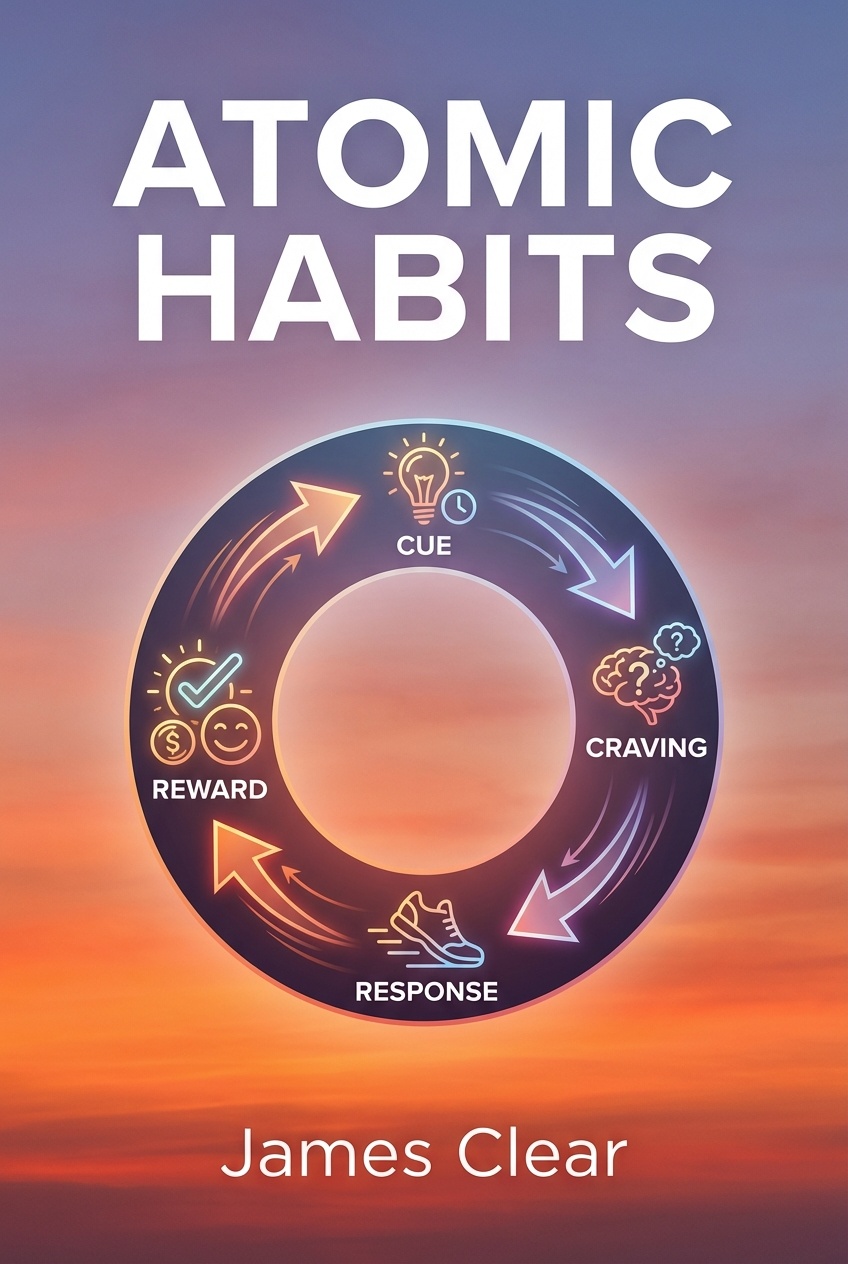
Every habit, good or bad, follows a four-step neurological feedback loop: cue, craving, response, and reward. This loop is the backbone of all human behavior. The first step is the 'cue,' which is a trigger that tells your brain to initiate a behavior. It's a piece of information that predicts a reward. For example, the notification sound from your phone is a cue. The cue then leads to the second step, the 'craving,' which is the motivational force behind every habit. You don't crave the habit itself but the change in state it delivers. You don't crave scrolling on Instagram; you crave the feeling of entertainment or distraction it provides.\n\nThe third step is the 'response,' which is the actual habit you perform—the thought or action. Whether you act on the craving depends on the amount of friction associated with the behavior. Finally, the fourth step is the 'reward.' The reward is the end goal of every habit; it satisfies your craving and teaches your brain which actions are worth remembering in the future. This entire cycle—cue, craving, response, reward—creates an automatic loop that, over time, becomes a habit. Understanding this framework is essential because it provides a clear roadmap for how to build good habits and break bad ones by manipulating each of the four steps.
The first law of behavior change focuses on the initial step of the habit loop: the cue. Many of our daily habits are performed on autopilot, without conscious thought. Therefore, the process of changing our behavior must begin with awareness. To build good habits, we need to make the cues for them prominent and visible in our environment. Conversely, to break bad habits, we should make their cues invisible. This theme emphasizes that our environment is a powerful, often unseen, force that shapes our actions. By consciously designing our surroundings, we can make it easier to trigger the habits we want and harder to fall into the ones we don't. Techniques like the Habits Scorecard help bring unconscious behaviors to light, while strategies like Implementation Intentions and Habit Stacking provide clear, actionable plans for integrating new habits into our existing routines. The central idea is that the most effective way to start a new habit is to make the trigger for it as obvious as possible.
The Habits Scorecard is a simple exercise designed to increase your awareness of your daily behaviors. The process involves listing all of your daily actions, from the moment you wake up until you go to sleep. This can include things like 'wake up,' 'check phone,' 'brush teeth,' 'make coffee,' and so on. Once you have your list, you go through each habit and label it as positive (+), negative (-), or neutral (=) based on how it contributes to your long-term goals and desired identity. There is no need to judge yourself or make any changes at this stage; the sole purpose of the exercise is to observe your own behavior without judgment.\n\nThis technique is powerful because many of our habits are so ingrained that we perform them unconsciously. We are often unaware of the small, repeated actions that are either helping or hurting us. The Habits Scorecard brings these automatic behaviors into your conscious awareness, which is the essential first step before you can begin to change them. By simply noticing what you do each day, you can identify patterns and pinpoint the specific habits you want to cultivate or eliminate. This clarity allows you to move forward with intention rather than continuing to operate on autopilot.
An implementation intention is a specific plan you make about when and where you will perform a new habit. Many people are vague about their intentions, saying things like 'I will exercise more' or 'I will read more.' This lack of clarity makes it easy to procrastinate or forget. An implementation intention combats this by clearly defining the circumstances for the action. The formula is simple: 'I will [BEHAVIOR] at [TIME] in [LOCATION].' For example, instead of a vague goal to meditate, you would create an implementation intention like, 'I will meditate for ten minutes at 7:00 AM in my living room.'\n\nThis strategy is effective because it pre-loads the decision-making process. By deciding in advance when and where you will act, you eliminate the need for in-the-moment motivation or deliberation. The time and location act as the cue for the habit, making it obvious and prompting you to take action. Research has shown that people who create a specific plan for their new habits are significantly more likely to follow through. It provides a clear trigger and removes the ambiguity that often leads to inaction, making it one of the most straightforward and powerful ways to ensure you stick to a new routine.
Habit stacking is a strategy for building a new habit by pairing it with a habit you already do consistently. Instead of relying on a time or location as the cue, you use a current, well-established habit as the trigger for the new one. The brain has already built strong neural pathways for your existing habits, and by linking a new behavior to this established cycle, you increase the likelihood that you'll remember to do it. The formula for habit stacking is: 'After/Before [CURRENT HABIT], I will [NEW HABIT].' For example, if you want to start a daily meditation practice and you already have a habit of drinking coffee every morning, your habit stack would be: 'After I pour my morning cup of coffee, I will meditate for one minute.'\n\nThis technique is powerful because it leverages the momentum of your existing routines. Your current habits are already automatic, so they serve as reliable cues. You can create 'habit stacks' by chaining multiple small behaviors together. For instance, your morning routine could become a stack: After I make my bed, I will do ten push-ups. After I do ten push-ups, I will take a shower. This method seamlessly integrates new behaviors into your daily life by anchoring them to the patterns that are already a part of your routine, making it one of the most effective ways to introduce new habits.
Environment design is the practice of consciously structuring your physical and digital spaces to make cues for good habits obvious and visible. The principle behind this is that our environment often has a more significant impact on our behavior than our willpower or motivation. We are more likely to perform a habit when the cue for it is right in front of us. For example, if you want to practice guitar more often, you should place your guitar in the middle of your living room, not hidden away in a closet. If you want to drink more water, you should fill up a water bottle and place it on your desk each morning.\n\nThis strategy works by embedding triggers for your desired behaviors into your daily surroundings. By making the cues a prominent part of your environment, you reduce the reliance on memory or motivation to initiate the habit. The visual prompt does the work for you. This concept applies to all aspects of life. To eat healthier, you can place healthy foods at eye level in your pantry and fridge. To read more, you can leave a book on your pillow. The central idea is to create a space where the easiest and most obvious choice is the good habit you want to build. It's a simple but incredibly effective way to automate good decisions.
Just as you can design your environment to make good habits obvious, you can also design it to make bad habits invisible. This is the inversion of the first law. The idea is that self-control is often a short-term strategy that fails in the long run. A more effective approach is to remove the temptations from your environment altogether. If the cue for a bad habit is not present, you are far less likely to engage in the behavior. For example, if you want to stop eating junk food, the most effective strategy is to not buy it and remove it from your house. If you want to reduce your screen time, you can leave your phone in another room while you work.\n\nThis approach recognizes that it is easier to avoid a temptation than to resist it. By making the cues for your bad habits invisible, you are essentially removing the first step of the habit loop, preventing the cycle from even beginning. This is a more reliable strategy than relying on willpower, which can be depleted by stress, fatigue, and other daily challenges. By curating your environment, you can eliminate the triggers that lead to your bad habits, making it easier to stick to your long-term goals. It's a proactive way to exercise self-control by creating a space that naturally encourages better choices.
Create a free account to read the remaining themes and key concepts from this book.
Create an accountThe second law of behavior change focuses on the 'craving' phase of the habit loop. Habits are essentially dopamine-driven feedback loops; when we anticipate a reward, our dopamine levels rise, which motivates us to act. To build a good habit, we need to make it more appealing and desirable. This theme explores how to engineer a craving by associating our habits with positive feelings and social norms. Strategies like 'Temptation Bundling' work by linking something you want to do with something you need to do, making the necessary habit more attractive. The power of social influence is also a major focus. We are heavily influenced by the norms of the groups we belong to—our family, friends, and community. By joining a culture where our desired behavior is the normal behavior, we can leverage our natural human desire to fit in to our advantage. Finally, reframing our mindset to focus on the benefits of good habits, rather than their drawbacks, can make them seem more attractive and worth pursuing.
Temptation bundling is a strategy that makes a habit more attractive by linking an action you *want* to do with an action you *need* to do. The principle is to pair a long-term beneficial habit that you may be avoiding with an instant gratification 'want.' For example, if you need to exercise more but want to watch your favorite TV show, you could create a rule for yourself: 'I can only watch Netflix while I'm on the treadmill.' Or, if you need to process work emails but want to listen to a podcast, you can bundle them together: 'I will only listen to my favorite podcast while clearing out my inbox.'\n\nThis technique works by leveraging the dopamine spike from the enjoyable activity to pull you through the less enjoyable but necessary one. The anticipation of the reward (the 'want') makes the habit you need to do more attractive. It transforms a task that feels like a chore into an opportunity for a small pleasure. This strategy is a direct application of making a habit attractive, as it attaches an immediate reward to a behavior that might otherwise be unappealing, increasing the likelihood that you will follow through with it consistently.
One of the most powerful forces that shape our habits is the desire to fit in with our social groups. We are constantly influenced by the behaviors of those around us, and we have a natural tendency to adopt the habits that are considered normal by our culture. To build better habits, you can leverage this by surrounding yourself with people for whom your desired behavior is the norm. If you want to become more well-read, join a book club. If you want to get fit, join a running group or a gym where people are consistently working out. When you are part of a group where the desired behavior is standard practice, it feels more achievable and attractive.\n\nThis strategy works because it shifts your perception of what is normal. Being surrounded by people who are already doing what you want to do provides both social proof and a sense of belonging. The shared identity of the group reinforces your own personal identity. Instead of feeling like you are struggling alone, you feel like you are part of a community. This social environment makes sticking to your habits easier because it's not just a personal goal anymore; it's part of fitting in with your tribe. The desire to belong is a powerful human motivator that you can use to your advantage.
Our habits are often shaped by the people we are closest to: our family and friends. We tend to imitate the behaviors of those around us, especially those we admire or spend the most time with. This influence can be both positive and negative. If your friends all smoke, you are more likely to smoke. If your family eats healthy meals together, you are more likely to adopt healthy eating habits. This happens because the behaviors of our close social circles define what is 'normal' and acceptable to us. We don't consciously choose to adopt these habits; we absorb them through exposure and the desire for social connection.\n\nThis concept highlights the importance of being mindful of your social environment. The people you spend time with are essentially casting votes for the type of person you become. While you can't always choose your family, you can be more intentional about the friendships and social groups you cultivate. Surrounding yourself with people who have the habits you want to adopt is one of the fastest ways to pull your own behavior in that direction. Recognizing the powerful, often subtle, influence of your social circles is the first step toward consciously shaping an environment that supports your goals rather than sabotages them.
The way we think about a habit plays a crucial role in how attractive it seems. Our feelings and emotions are driven by our interpretation of events, not just the events themselves. You can make a habit more attractive by changing the way you frame it in your mind. Instead of focusing on the difficulty or sacrifice involved in a good habit, you can reframe it to highlight its benefits. For example, instead of thinking, 'I *have* to go for a run,' you can think, 'I *get* to build endurance and feel energized.' This simple shift in language can change your perception of the task from a burden to an opportunity.\n\nSimilarly, you can make a bad habit less attractive by highlighting its drawbacks. Instead of thinking about the immediate pleasure of a cigarette, you can focus on the long-term damage it does to your health and the money it costs. This mental shift associates the bad habit with a negative feeling, reducing its appeal. The key is to consciously change your internal narrative. By repeatedly associating good habits with positive outcomes and bad habits with negative ones, you can reprogram your brain to find the desired behaviors more attractive and the undesired ones less appealing. This is a powerful way to influence your cravings at their source.
The third law of behavior change targets the 'response' phase of the habit loop. The core idea is that human behavior follows the Law of Least Effort; we naturally gravitate toward the option that requires the least amount of work. To build good habits, we need to reduce the friction associated with them, making them as easy and convenient as possible. Conversely, to break bad habits, we should increase the friction, making them more difficult to perform. This theme is about designing an environment and a process that makes doing the right thing effortless. The more steps, time, or energy a habit requires, the less likely we are to stick with it. Strategies like the 'Two-Minute Rule' help to overcome the initial resistance to starting a new habit by scaling it down to something incredibly simple. The use of 'commitment devices' serves as a way to increase friction for bad habits, locking in future good behavior. The ultimate goal is to make good habits the path of least resistance.
Friction is the collection of small obstacles and steps that stand between you and performing a habit. The more friction there is, the less likely you are to follow through. Reducing friction means making your good habits as convenient and simple as possible. This often involves designing your environment to prime you for action. For example, if you want to go to the gym in the morning, you can reduce friction by laying out your workout clothes, packing your gym bag, and preparing your pre-workout meal the night before. Each small step you complete in advance removes a point of friction that could otherwise derail your intention.\n\nThe central idea is to decrease the number of steps between you and the good habit. The goal is to create an environment where doing the right thing is the easiest possible choice. This could mean placing your vitamins next to your toothbrush, keeping healthy snacks in plain sight, or setting up your workspace so that starting your most important task is seamless. By systematically removing the small barriers that cause you to hesitate or procrastinate, you make it significantly easier to be consistent with your desired behaviors.
Just as you can make good habits easier by reducing friction, you can break bad habits by increasing it. This is the inversion of the third law: make it difficult. The more steps, effort, or inconvenience you add to a bad habit, the less likely you are to perform it. This strategy works by creating a buffer between the craving and the response, giving you time to reconsider your actions. For example, if you want to watch less television, you could unplug the TV after each use and take the batteries out of the remote. The extra effort required to start watching gives you a moment to ask yourself if that's really what you want to do.\n\nIncreasing friction is a practical way to combat impulsive behaviors. If you want to reduce impulse purchases, you could remove your saved credit card information from online stores or even freeze your credit card in a block of ice. If you spend too much time on your phone, you can log out of social media apps after each session, forcing you to re-enter your password each time. By deliberately adding small obstacles, you make the bad habit less convenient and therefore less appealing. This is a more effective strategy than relying on pure willpower to resist temptation.
The Two-Minute Rule is a strategy designed to overcome procrastination and make new habits incredibly easy to start. The rule states: 'When you start a new habit, it should take less than two minutes to do.' The idea is to scale down any habit into a simple, two-minute version. For example, 'read before bed' becomes 'read one page.' 'Do 30 minutes of yoga' becomes 'take out my yoga mat.' 'Run three miles' becomes 'tie my running shoes.' The goal is not to achieve the full habit immediately, but to master the art of showing up.\n\nThis technique works by focusing on the 'gateway' moment of the habit. The most difficult part of any new routine is often just getting started. By making the starting ritual so easy that you can't say no, you build momentum. Once you've started doing the right thing, it's much easier to continue. The Two-Minute Rule is not about the two minutes of action; it's about building the habit of starting. It's a way to automate the beginning of a larger routine. Once you've established the initial habit, you can gradually increase the duration and difficulty over time.
A commitment device is a choice you make in the present that controls your actions in the future. It is a way to lock yourself into good habits and lock yourself out of bad ones. These devices work by creating consequences for your behavior, making it difficult or costly to backslide. For example, to commit to eating healthier, you could pre-order healthy meals for the week. This automates your good decision and increases the friction of eating junk food, as you would have already paid for the healthy option. To commit to saving money, you could set up an automatic transfer to a savings account that is difficult to access.\n\nCommitment devices are essentially ways to increase the friction for bad habits and reduce it for good ones, often by using social or financial incentives. You could give a friend $100 and tell them to keep it if you don't go to the gym three times that week. This creates a negative consequence for inaction. The key is that these are choices you make voluntarily to hold your future self accountable. They are a powerful way to overcome the human tendency to prioritize short-term gratification over long-term goals by making the long-term choice easier and the short-term temptation harder.
The fourth and final law of behavior change addresses the 'reward' phase of the habit loop. The core principle is that what is immediately rewarded is repeated, and what is immediately punished is avoided. For a habit to stick, it needs to be enjoyable and satisfying. Many good habits have delayed rewards; the benefit of exercising today won't be visible for months. Conversely, many bad habits have immediate rewards but delayed consequences. This law focuses on how to bridge that gap by adding a little bit of immediate pleasure or satisfaction to your good habits. This reinforces the behavior and makes you more likely to repeat it. Techniques like using a habit tracker provide a visual sense of accomplishment, while accountability partners and habit contracts introduce immediate social consequences that can help keep you on track. The goal is to ensure that your good habits end with a satisfying reward, closing the habit loop and encouraging repetition.
The human brain is wired to prioritize immediate gratification over long-term rewards. This is a primary reason why it's hard to stick to good habits (delayed rewards) and easy to fall into bad ones (immediate rewards). To make a good habit stick, you need to find a way to attach an immediate sense of satisfaction to it. The reward doesn't have to be elaborate; it just needs to be a small, positive reinforcement that signals the completion of the habit. For example, after a workout, you could reward yourself with a healthy smoothie you enjoy. After completing a difficult work task, you could take a five-minute break to listen to your favorite song.\n\nThis strategy works by closing the habit loop and giving your brain a reason to repeat the behavior. The immediate reward creates a positive feeling that becomes associated with the habit, making you more likely to perform it again in the future. The key is that the reward must be immediate and must align with your desired identity. For example, rewarding yourself with a bowl of ice cream after a workout might send a conflicting message. The goal is to find small, healthy ways to feel successful right after you complete your habit, which trains your brain to look forward to the action itself.
A habit tracker is a simple tool for measuring whether you did a habit. The most basic format is a calendar where you put an 'X' on each day you successfully complete your desired behavior. This simple act of tracking is powerful for several reasons. First, it creates a visual cue that reminds you to act. Second, it is motivating to see your streak of successful days grow, and you won't want to 'break the chain.' Third, it provides an immediate sense of satisfaction to record your success, which serves as a reward.\n\nHabit tracking provides clear evidence of your progress, which is inherently satisfying. It shifts the focus from the long-term result to the daily process of showing up. Even on days when you don't feel like you're making progress, the tracker shows that you are being consistent. It also helps you to be honest with yourself about your actions. The book also introduces a key rule for when you inevitably miss a day: 'never miss twice.' Missing one day is an accident, but missing two days is the start of a new (bad) habit. This rule allows for imperfection while encouraging you to get back on track as quickly as possible.
An accountability partner is someone who you report your progress to on a regular basis. This strategy works by adding a layer of social pressure to your habits. We care about what others think of us, and we are less likely to skip a commitment if we know someone is watching. The simple act of knowing that someone will be checking in on you can be a powerful motivator to follow through. An accountability partner can provide encouragement and support, but their primary role is to create an immediate cost to inaction. The pain of disappointing someone else can be a stronger driver than the desire for personal gain.\n\nThis technique is an effective way to make your habits more satisfying (or unsatisfying, if you fail). The praise and respect you get from your partner for being consistent serves as an immediate social reward. Conversely, the shame or disappointment of having to admit that you didn't follow through serves as an immediate social punishment. This is particularly effective for habits that are performed in private and are easy to skip without anyone knowing. By adding a social element, you raise the stakes and make it more likely that you will stick to your commitments.
A habit contract is a formal, written agreement that outlines the consequences for your actions. It is a way to make the costs of your bad habits public and painful, and the rewards for your good habits clear and satisfying. A habit contract should clearly state the habit you are trying to build or break and the consequences for both succeeding and failing. For example, a contract to quit smoking might state that for every day you go without a cigarette, you put $25 into a vacation fund (a reward). If you smoke, you have to give $100 to a friend (a punishment). The contract should be signed by you and one or more accountability partners who will enforce the terms.\n\nThis strategy is a powerful way to create immediate consequences for your behavior, which is a core principle of the fourth law. It makes the long-term outcomes of your habits tangible in the present moment. The contract formalizes the process of accountability and removes any ambiguity. It is a commitment device that uses social and financial incentives to ensure you follow through. By putting stakes on the line, you are raising the importance of your promise to yourself and making it much harder to back down when your motivation wanes.
Once you have established good habits using the Four Laws of Behavior Change, the journey shifts from building habits to maintaining them and achieving peak performance. This final section delves into the strategies needed to sustain progress over the long term and break through plateaus. It addresses the challenge of staying motivated when habits become routine and boring. The 'Goldilocks Rule' provides a framework for maintaining engagement by working on challenges that are perfectly matched to your current abilities—not too hard, but not too easy. This theme also emphasizes the critical role of continuous self-improvement through regular reflection and review. True mastery is not just about mindless repetition; it's about consciously evaluating your performance and looking for ways to get better. These advanced tactics are what separate the good from the great, providing a roadmap for lifelong growth and refinement.
The Goldilocks Rule states that humans experience peak motivation when working on tasks that are right on the edge of their current abilities—not too hard, and not too easy, but 'just right.' If a task is too easy, we become bored and disengaged. If a task is too difficult, we become frustrated and discouraged. The sweet spot for motivation is found in challenges of 'just manageable difficulty.' This is the state of 'flow,' where you are fully immersed and engaged in an activity. The optimal level of difficulty is often cited as being about 4% beyond your current skill level.\n\nThis principle is crucial for long-term progress. While the Third Law, 'Make It Easy,' is essential for starting a habit, once the habit is established, you need to find ways to keep it engaging. This means gradually increasing the difficulty in small increments to stay in that optimal zone of motivation. For example, if you've mastered lifting a certain weight at the gym, you need to add a little more weight to keep the challenge engaging. The Goldilocks Rule provides a framework for continuous improvement by ensuring that your habits evolve with your abilities, preventing the boredom that can lead to quitting.
Simply repeating a habit is not enough for mastery; you also need to engage in regular reflection and review. This process involves periodically taking a step back to assess your progress, identify areas for improvement, and ensure your habits are still serving you. Without reflection, it's easy to slip into mindless repetition, where you continue to perform the habit but stop getting better. A regular review process allows you to make small adjustments and course corrections that can lead to significant long-term gains. It helps you notice small errors before they become ingrained and identify new opportunities for growth.\n\nThis practice can be as simple as a weekly or monthly check-in where you ask yourself questions like: What went well this month? What didn't go so well? What am I working toward? Are my current habits still aligned with my desired identity? This process of self-evaluation brings a level of conscious awareness to your habits that is essential for long-term improvement. It ensures that you are not just going through the motions but are actively engaged in the process of becoming better. Reflection and review are what turn practice into deliberate practice, which is the key to achieving expertise.
At the beginning of a new habit, progress is often rapid and exciting. However, as you become more skilled, the rate of improvement slows down, and the habit can become routine and boring. This is a critical point where many people fail. The ability to stick with a habit when it is no longer novel or exciting is what separates professionals from amateurs. Professionals stick to the schedule even when they don't feel like it; amateurs let life get in the way. The greatest threat to long-term success is not failure, but boredom. Once a habit is established, the challenge is to stay engaged and not let the routine become monotonous.\n\nTo overcome this, it's important to fall in love with the process, not just the outcome. While the Goldilocks Rule can help by introducing new challenges, there will always be days when the work feels like a grind. On these days, it's your commitment to the system that will carry you through. It's about showing up even when you're bored. You can also introduce variability into your routine to keep it interesting. For example, if you are a runner, you could explore new routes or try different types of running workouts. The key is to find a balance between consistency, which is necessary to build the habit, and novelty, which is necessary to stay engaged.
Hear the key concepts from this book as an engaging audio conversation.
Listen to Podcast