
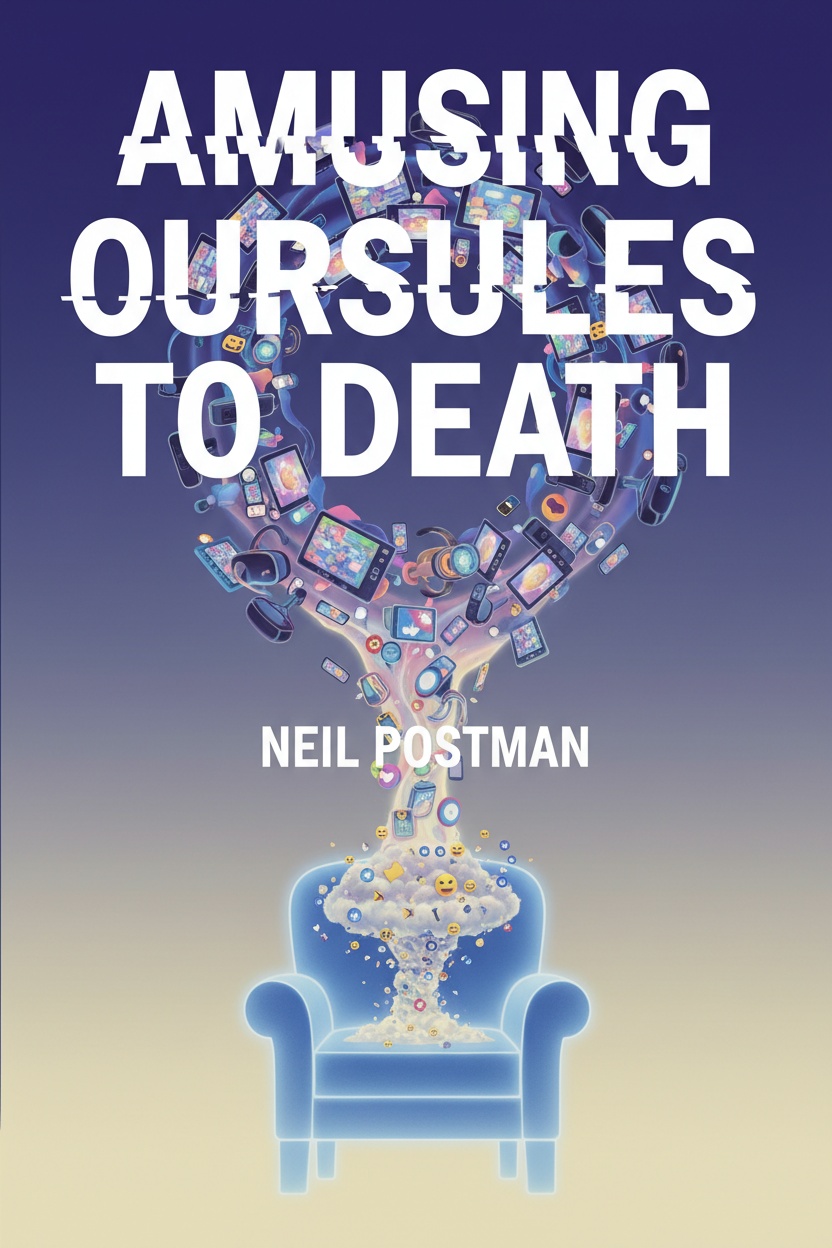
Why You should Read This Book?
This book prophetically argues that the rise of television and visual culture fundamentally changed public discourse, turning serious issues into entertainment and trivializing our understanding of the world. It’s a crucial read for understanding how our society became prone to distraction and superficiality, making its insights even more critical in today's digital age dominated by social media and short-form content. Reading it will equip you with a powerful framework to critically assess information, recognize the dangers of entertainment-driven communication, and understand the subtle ways media shapes our minds.
Listen to PodcastDialogue turns nonfiction books into engaging podcast mini-series between two hosts, making key ideas easy to absorb on the go. It uses science-backed learning techniques to strengthen memory formation and complements the book's insights with supporting scientific evidence.
In "Amusing Ourselves to Death," the central argument begins with the idea that the medium through which we communicate is not just a neutral container for information; it is a metaphor that shapes how we understand reality. Neil Postman builds on Marshall McLuhan's famous phrase "the medium is the message," but refines it to "the medium is the metaphor." He argues that each communication technology, from the printed word to television, has inherent biases that influence what kinds of ideas can be conveniently expressed. This means that the form of our media actively structures the content of our culture, defining what we consider to be true, important, and real. For example, a culture that gets its information from smoke signals cannot develop complex philosophical arguments, just as a culture dominated by television struggles to engage in deep, rational discourse because the medium itself favors fast-paced, visual entertainment.\n\nThis concept extends to all areas of life, suggesting that our tools and technologies redefine our world in subtle but powerful ways. The invention of the clock, for instance, didn't just measure time; it transformed our perception of time from a continuous, natural flow into a series of precise, mathematical units. Similarly, television does more than just transmit shows; it redefines public discourse—politics, religion, news, and education—by framing all of it as a form of entertainment. Postman's core concern is that as our primary medium has shifted from the printed word to the television image, our entire cultural conversation has become less serious, less rational, and ultimately, less meaningful. The way we receive information shapes our intellectual habits and, in turn, the very character of our society.
The way a society communicates fundamentally shapes what that society talks about and how it thinks. Postman argues that the dominant medium of an era dictates the form and, consequently, the substance of public conversation. A medium isn't just a pipeline for messages; it has built-in biases that favor certain types of content over others. For example, the printed word, with its linear and logical structure, naturally supports complex, rational, and coherent arguments. A culture dominated by print will therefore value and engage in deep, substantive public discourse.\n\nIn contrast, a medium like television, which relies on rapid, dynamic, and emotionally engaging visual images, shapes public discourse to be more like entertainment. Serious topics such as politics, news, and religion are forced to adapt to the demands of this new medium, becoming simplified, sensationalized, and presented as spectacle. The result is a shift in the entire 'symbolic environment,' where the seriousness and clarity of public discourse decline because the central medium no longer supports them. The medium doesn't just carry the message; it fundamentally alters the nature of the conversation itself, determining which ideas are considered important and how they are discussed.
Every medium of communication has a built-in prejudice that shapes how we perceive and understand the world. This bias isn't about political leaning; it's about the medium's natural tendency to favor certain forms of expression and, therefore, certain ways of thinking. Postman explains that media act as metaphors, framing our reality in specific ways. For example, the technology of writing freezes speech, allowing for the development of logic, grammar, and science because it enables ideas to be scrutinized and analyzed over time. The bias of print is toward rationality and order.\n\nTelevision, on the other hand, has a powerful bias toward the visual, the immediate, and the emotional. Its language is imagery, and its goal is to keep the viewer watching with a constant stream of new and engaging pictures. This bias means that television must suppress complex ideas in favor of visual interest and the values of show business. As a result, a culture dominated by television will start to perceive reality through the lens of entertainment. Truth and importance become linked to how visually appealing or emotionally gratifying something is, rather than its logical coherence or factual accuracy. This subtle but powerful influence redefines what a culture values as knowledge and truth.
Postman begins his book by contrasting two famous dystopian novels: George Orwell's *Nineteen Eighty-Four* and Aldous Huxley's *Brave New World*. While many feared an Orwellian future where an oppressive state would control the population by banning books, censoring information, and inflicting pain, Postman argues that this is not the danger facing modern Western societies. Instead, he contends that Huxley's vision is far more prophetic. In Huxley's world, control is achieved not through force, but through pleasure. The population is subdued by an endless stream of amusements, distractions, and trivialities that they willingly embrace.\n\nHuxley feared a world where there would be no reason to ban a book, because no one would want to read one. He foresaw a society so saturated with information and entertainment that people would be reduced to passivity, their capacity for critical thought drowned in a sea of irrelevance. Postman argues this is precisely what has happened in the age of television. We are not oppressed by a 'Big Brother' who watches our every move; instead, we willingly watch 'Big Brother' as a form of entertainment. The danger is not that we will be deprived of information, but that we will be given so much of it that we become indifferent and amused into submission. We are not ruined by what we hate, but by what we love.
The Age of Typography refers to the period when the printed word held a monopoly on public discourse, particularly in Colonial and 18th- and 19th-century America. During this time, the way people communicated and thought was profoundly shaped by the characteristics of print. Because print is a rational, linear, and coherent medium, it fostered a public discourse that valued logic, order, and substantive argumentation. The very act of reading requires sustained attention and the ability to follow complex lines of thought, which in turn cultivated a 'typographic mind' in the general population. This mindset was not limited to an intellectual elite; literacy was widespread, and there was a common expectation that public figures, from politicians to preachers, would present their ideas through well-reasoned, text-based arguments.\n\nThis era was characterized by a seriousness in public life that is difficult to imagine today. Political debates, like the famous Lincoln-Douglas debates, could last for hours, with audiences attentively following every point and counterpoint. Even advertisements from this period were text-heavy, appealing to the reader's reason rather than their emotions. The dominance of print as the primary medium for information meant that ideas, not images, were the currency of public life. This environment created a high standard for public communication, demanding clarity, coherence, and intellectual rigor from both the speaker and the audience. The world was understood and engaged with through the written word, creating a culture centered on rational thought and complex ideas.
In an era dominated by the printed word, the nature of public conversation was inherently rational and serious. Postman argues that the medium of print itself encourages a logical and sequential way of thinking. To read, one must follow a line of reasoning from beginning to end, processing complex sentences and abstract ideas in an orderly fashion. This mental discipline, required by the medium, was reflected in the public discourse of the time. Speeches, sermons, and political arguments were expected to be well-structured, content-rich, and free of contradiction. The audience, accustomed to the logic of the printed page, had the patience and intellectual training to follow these intricate arguments for extended periods.\n\nBook Story: Postman uses the 1858 Lincoln-Douglas debates as a prime example of this typographic culture. These debates were not soundbites or photo opportunities; they were lengthy, complex, and highly substantive events, often lasting for seven hours. Abraham Lincoln and Stephen Douglas presented their arguments with intricate logic and detailed evidence, and the audiences, composed of ordinary citizens, were expected to listen attentively and evaluate the coherence of what was being said. This kind of engagement was possible because both the speakers and the listeners shared a common intellectual framework shaped by the printed word—a world where ideas were paramount and were expected to be presented and understood through the rigors of rational exposition.
Contrary to modern assumptions, early America was a remarkably literate society where the printed word was the central medium of communication for people of all social classes. From the earliest colonial days, reading was not considered an elitist activity but a common skill. This widespread literacy created a culture in which public discourse, whether in pamphlets, newspapers, or public speeches, was expected to meet a high intellectual standard. The public had an appetite for substantive content and possessed the ability to comprehend complex, text-based arguments. The monopoly of print meant there were few competing forms of information, so people devoted their time to reading and discussing the written word.\n\nThis expectation for coherence and substance was evident in all areas of public life. For example, preachers were revered for their theological knowledge and their ability to deliver long, intricate sermons that methodically analyzed religious texts. Similarly, political figures gained respect through the power and logic of their written and spoken words, not their physical appearance or charisma. The shared culture of reading created a public that was not merely informed, but also capable of critically evaluating the information it received. They expected arguments to be orderly, fact-based, and serious, reflecting the very nature of the printed page itself.
The very structure of the printed word fosters a particular way of thinking—one that is analytical, sequential, and capable of handling abstraction. A written sentence is a self-contained proposition that makes an assertion, and a paragraph builds upon these assertions to form a logical argument. This format requires the reader to follow a train of thought, to connect preceding ideas with what comes next, and to evaluate the overall coherence of the argument. Because written text has a tangible, paraphraseable content, it invites analysis and critique. This inherent rationality of print meant that the content it carried tended to be serious and idea-driven.\n\nPostman argues that it is no coincidence that the Age of Reason unfolded alongside the rise of print culture. The printing press made knowledge accessible and created a symbolic environment where the intellect was trained to think in a logical, orderly manner. This 'typographic mind' was adept at classifying information, identifying contradictions, and understanding complex ideas. The content of newspapers, pamphlets, and books of the era reflected this, focusing on reasoned debate and the exposition of facts. Even early advertising relied on text-heavy explanations of a product's merits, appealing to the consumer's rational judgment rather than their emotions or impulses.
Create a free account to read the remaining themes and key concepts from this book.
Create an accountThe 'Peek-a-Boo' World is Postman's metaphor for the new information environment created by the inventions of the telegraph and the photograph in the mid-19th century. These technologies marked the beginning of the end for the Age of Typography by fundamentally changing the nature of information. For the first time, communication was separated from transportation, allowing information to travel instantaneously across vast distances. This technological shift brought about a flood of news that was largely irrelevant to the daily lives of the people receiving it. Information became a commodity, valued for its novelty and sensationalism rather than its context or usefulness.\n\nThis new world is one where events and images pop into our consciousness for a moment, only to be immediately replaced by the next, unrelated thing—much like the children's game of peek-a-boo. The result is an information landscape that is incoherent, fragmented, and disconnected from any meaningful context. The photograph contributed to this by shifting the focus from propositions and ideas (the domain of language) to concrete, isolated moments (the domain of images). This 'peek-a-boo' environment entertains us with a constant stream of novelties but does not permit or encourage us to think deeply, reflect, or take meaningful action based on the information we receive. It creates the illusion of being informed while fostering a reality of amused indifference.
The dominance of the rational, print-based culture began to erode in the mid-19th century with the arrival of two revolutionary technologies: the telegraph and the photograph. The telegraph was the first to sever the link between communication and physical transportation, making it possible for information to travel faster than a human being. This innovation created the possibility of a national conversation, but it came at a cost. The telegraph's strength was speed, not depth, and it began to fill newspapers with information from faraway places that was novel and interesting but ultimately irrelevant to the lives of most readers. Information was transformed from something you act upon to something you simply know about.\n\nPhotography further accelerated this decline by introducing a new, powerful form of communication that privileged the image over the word. A photograph presents a concrete moment, stripped of context, and does not make assertions or arguments in the way that language does. Together, the telegraph and the photograph created a new definition of information: one that was decontextualized, fragmented, and sensational. This marked a fundamental shift away from the coherent, logical world of typography and laid the groundwork for a new era where public discourse would be defined by immediacy and visual spectacle rather than reasoned exposition.
The telegraph's primary contribution to journalism was the creation of the 'headline'—short, sensational snippets of information largely disconnected from each other. News became a series of facts that did not need to fit into a larger, coherent narrative. A story about a flood in one country could be immediately followed by a report on a political scandal in another, with no connection between them. Postman argues this created a public discourse defined by irrelevance, impotence, and incoherence. The information was irrelevant because it had little to do with the reader's local context and decision-making. It rendered the reader impotent because there was often no meaningful action they could take based on this distant news. And it was incoherent because it presented the world as a series of disconnected events that vanished as quickly as they appeared.\n\nThis created what Postman calls the 'peek-a-boo world,' where information pops into view for a moment only to be replaced by something else, preventing sustained thought or reflection. The photograph amplified this effect. It captures a single moment in time, isolated from what came before or after, presenting reality as a collection of frozen, context-free fragments. The partnership between the telegraph's disembodied facts and the photograph's isolated images created a pseudo-context—the illusion of understanding without any of the depth, history, or continuity that typography had once provided. This new media environment trained the public to accept a world of disjointed information, paving the way for the even more fragmented world of television news.
The rise of photography marked a crucial turning point in public discourse by shifting the primary mode of representation from the word to the image. Language, especially in its printed form, deals with ideas, propositions, and abstractions. It presents the world as a concept to be understood. A photograph, however, presents the world as an object to be seen. It captures a specific, concrete reality but cannot, on its own, offer generalizations, arguments, or nuanced commentary. While a photograph is often perceived as an objective record of reality, it is inherently context-free, showing only a slice of a moment without a past or future.\n\nThis shift had profound consequences. As images became a more central part of public communication, particularly in news and advertising, there was a corresponding decline in the value placed on reasoned argument. Appearance began to matter more than substance. For example, in the typographic age, a politician was known by their written words and the logic of their arguments. In the emerging age of the image, how they looked in a photograph could become just as, if not more, important. This transition from a word-centered to an image-centered culture laid the foundation for television, where the visual would become the ultimate arbiter of what is true, important, and real.
The Age of Show Business is Postman's term for the contemporary era in which television has become the dominant medium, and its values have permeated all aspects of public life. The fundamental and unalterable bias of television is entertainment. Regardless of the content being presented—whether it's news, politics, religion, or education—the medium of television demands that it be packaged as an amusing and visually engaging spectacle to hold the viewer's attention. This is not a conscious conspiracy by producers, but an inherent requirement of the technology itself, which communicates through a rapid succession of pleasing images. As a result, television has transformed every form of public discourse into a branch of show business.\n\nIn this new age, the primary question is not whether something is true, rational, or important, but whether it is entertaining. Complex issues are necessarily simplified, nuanced discussions are replaced by dramatic confrontations, and logical arguments are subordinated to charismatic personalities and good looks. The problem, as Postman sees it, is not that television offers us entertaining programs; it's that television insists that all programs and all subjects must be entertaining. This has created a culture where we no longer talk to each other but entertain each other, exchanging images instead of ideas. The metaphor for all public life has become show business, fundamentally altering what we value as knowledge and how we engage with the world.
In the latter half of the 20th century, television surpassed print to become the culture's primary mode of understanding the world. As the dominant medium, it began to dictate the form that all public communication should take. Postman argues that television is not just one of many media; it has become the overarching metaphor for how we engage with reality. Its way of presenting the world—fast-paced, visual, fragmented, and entertaining—has become the model for how other areas of life should be conducted. We now expect politics, religion, education, and even our courtrooms and boardrooms to be as engaging and entertaining as a television show.\n\nThis means that other media have started to mimic television's format to remain relevant. For instance, newspapers like *USA Today* were explicitly designed to look like television, with short articles, lots of pictures, and colorful graphics. Radio news adopted a more discontinuous and sensationalized style. The influence is so pervasive that we have stopped noticing it. We have accepted that a political debate should be a spectacle of one-liners and that a church service should have the production values of a variety show. Television's grammar has become the grammar for all public life, and that grammar is rooted in the language of entertainment.
The medium of television is, by its very nature, biased toward entertainment. This is not a choice, but a technological reality. Television communicates through a constant stream of dynamic, visually pleasing images, with the average shot lasting only a few seconds. This format is perfectly suited for amusement and emotional gratification but is hostile to complex, abstract, or nuanced ideas. A thoughtful, logical argument is simply not 'good television' because it is not visually interesting. To survive on television, any subject matter must be adapted to fit the medium's requirements. It must be made visually stimulating, emotionally engaging, and, above all, entertaining.\n\nThis transforms everything into a form of show business. News is not presented to inform or educate, but to captivate an audience with dramatic music, attractive anchors, and sensational stories. Politics becomes less about policy and more about performance and image. Education on television must take the form of an amusing activity. Postman's critical point is that this is not a trivial matter. When entertainment becomes the 'supra-ideology' of all discourse, it fundamentally changes the nature of the information itself, often stripping it of its seriousness, context, and meaning.
Because television's language is the image and its goal is entertainment, it is incapable of sustaining complex or abstract discourse. An in-depth discussion of economic policy or a nuanced theological argument cannot be easily translated into the fast-paced, visually driven format of television. To make it onto the screen, such issues must be radically simplified. They are often reduced to a dramatic conflict between two opposing sides, represented by charismatic figures who can deliver concise, emotionally charged soundbites. The focus shifts from the substance of the issue to the spectacle of the presentation.\n\nThis process of simplification and dramatization turns public discourse into a series of entertaining performances rather than a genuine exploration of ideas. The viewer is positioned as a passive audience member to be amused, not an active citizen to be engaged. The result is a population that may feel informed because they have 'seen' the news or the debate, but they have only been exposed to a superficial and often misleading caricature of the complex reality. The spectacle satisfies our desire for amusement but undermines our capacity to understand and grapple with the difficult issues facing society.
As television's entertainment-focused grammar becomes the standard for all communication, every serious area of public life is diminished and trivialized. The relentless demand for amusement reshapes religion, politics, and news into shallow parodies of their former selves. Religion, a practice centered on profound spiritual contemplation, is transformed into a glitzy performance, with preachers becoming celebrities and faith being marketed like any other consumer product. The deep, sacred elements are stripped away to make it palatable and entertaining for a mass television audience, leaving a hollowed-out version that prioritizes feeling good over genuine spiritual engagement.\n\nSimilarly, political discourse, once grounded in reasoned argument and substantive policy debate, is reduced to a contest of images and soundbites. A candidate's viability is judged more on their telegenic appearance and ability to deliver a clever line than on the coherence of their ideas. The news, whose purpose is to create an informed citizenry, becomes a form of vaudeville. It presents a series of disconnected, sensationalized stories, often accompanied by dramatic music and attractive presenters, designed to capture and hold attention rather than to foster deep understanding. This results in a population that is saturated with information fragments but lacks the context and coherence to make sense of the world, a condition Postman describes as being informed but not truly knowledgeable.
When religion is presented on television, it must conform to the medium's inherent demand for entertainment. The result is that the most profound, sacred, and complex aspects of faith are pushed aside in favor of spectacle. Postman argues that the television environment is fundamentally secular and hostile to the conditions required for genuine religious experience, such as quiet contemplation, spiritual reverence, and intellectual rigor. On television, preachers become performers and celebrities, their success measured by ratings and audience appeal rather than spiritual wisdom.\n\nBook Story: Postman describes the phenomenon of the 'televangelist' as a prime example of this trivialization. To succeed on television, religious leaders must create a visually engaging 'show.' This often involves elaborate sets, musical performances, and a charismatic, theatrical preaching style. The message itself is often simplified to be easily digestible and emotionally uplifting, focusing on themes of prosperity and personal happiness. The difficult, challenging, and mysterious aspects of faith are omitted because they don't make for 'good television.' In this process, religion is stripped of its sacredness and transformed into another consumer product, marketed and sold to a passive audience seeking amusement and emotional gratification.
In the Age of Show Business, political discourse is no longer a 'typographic' affair concerned with reasoned arguments and policy debates. Instead, it has become a branch of advertising and entertainment, where image is everything. Television favors candidates who are telegenic and can perform well in front of a camera, regardless of their intellectual depth or the coherence of their ideas. Complex policy positions are boiled down into simplistic, memorable soundbites that can be easily packaged for a news segment. The visual impression a candidate makes—their appearance, their confidence, their likability—becomes more important than their political platform.\n\nPostman argues that this shift fundamentally degrades the democratic process. Voters are encouraged to act like a television audience, choosing a candidate based on a fleeting emotional response rather than a rational evaluation of their arguments. Advertising techniques, which appeal to emotion and impulse, become the primary tools of political persuasion. The result is a political culture where substance is secondary to style, and the ability to project a compelling image is the most valuable political asset. This trivializes the serious business of governance and leaves the electorate less equipped to make informed decisions.
Television news, in its quest to be entertaining, presents the world as a series of disjointed and dramatic fragments. A typical news broadcast jumps from a story of war and tragedy to a celebrity scandal, then to a quirky human-interest piece, all punctuated by commercials. The anchor often maintains a pleasant and reassuring demeanor throughout, signaling to the viewer that none of this is to be taken too seriously. This format, with its signature phrase "Now... this," breaks the world into incoherent pieces, preventing the viewer from seeing any connections, context, or continuity. The information is presented without a past and without a future, existing only as a fleeting, attention-grabbing moment.\n\nThis constant stream of decontextualized information creates what Postman calls a state of 'information glut.' We are bombarded with facts, but we are given no framework to understand them. The result is a population that knows of many things but understands very little about them. We can recognize the names of places and people in the news, but we lack the deep, contextual knowledge required for genuine understanding. We have the illusion of being informed, but our knowledge is, as Postman describes it, a mile wide and an inch deep. This superficial awareness leads not to meaningful civic action, but to a state of amused and passive indifference.
The Huxleyan Warning is Postman's concluding thesis, which circles back to the book's opening comparison between Orwell and Huxley. He argues that the danger to modern society is not the Orwellian vision of an oppressive state forcing its will upon a captive population. Instead, the true threat is the Huxleyan scenario, where people come to love their oppression and adore the technologies that strip them of their ability to think. We are not being controlled by force or fear, but by our own infinite appetite for distractions and amusement. The spirit of our culture is being shriveled not because it is a prison, but because it has become a burlesque—a trivial, perpetual round of entertainment.\n\nPostman's ultimate warning is that we are willingly amusing ourselves to death. The problem is not that television and other media present us with trivial content, but that they have created a world where all content must be presented in an entertaining format to be considered legitimate. This trivializes public discourse and leads to a form of 'culture-death,' where serious conversation becomes impossible. The first and most crucial step toward resisting this fate is awareness. We must become conscious of the biases of our media and recognize how they are shaping our habits of mind. The danger, as Huxley saw it, was not that people were laughing instead of thinking, but that they did not know *why* they were laughing and why they had stopped thinking.
The core of Postman's warning is that our cultural decline is a voluntary one. We are not being forced into a state of distraction; we are choosing it because it is pleasurable. The 'enemy,' as he puts it, is not a menacing tyrant but an enemy with a smiling face. We have embraced a culture where public business has become a 'vaudeville act' and serious issues are treated as a form of 'baby-talk.' This happens when a population becomes an audience, passively consuming a constant stream of entertainment rather than actively participating as citizens.\n\nThis willing submission to triviality is what makes the problem so difficult to fight. Unlike an obvious, external oppression that people would naturally resist, the culture of amusement is seductive. We enjoy the distractions and the simple, entertaining narratives. The danger is that in our pursuit of constant amusement, we are sacrificing our capacity for critical thought, rational debate, and meaningful civic engagement. We are, in essence, loving the very technologies and cultural forms that are undermining our ability to function as a thoughtful, democratic society.
Postman is careful to clarify that he is not against entertainment itself. He acknowledges that television can be enjoyable and that there is nothing wrong with amusement in its proper place. The true danger, he argues, is far more subtle and pervasive. The problem is that television has made entertainment the 'supra-ideology' of all communication. This means that entertainment is no longer just one type of content; it has become the required format for *all* content. To be seen, heard, and considered legitimate in the public sphere, everything—from politics and news to education and religion—must be packaged as entertainment.\n\nThis requirement fundamentally alters the nature of our public discourse. It means that complex ideas must be simplified, serious matters must be made light, and rational arguments must be replaced with emotional appeals and visual spectacles. The result is a culture that is increasingly unable to think seriously about anything, because its primary medium of conversation is structurally incapable of supporting serious thought. The danger is not that we watch sitcoms, but that our news, our politics, and our education are becoming more and more like sitcoms.
Postman does not end his book with a sense of complete despair. While he acknowledges that we cannot simply shut down our technological apparatus, he suggests that the beginning of a solution lies in education and awareness. The primary problem in the Huxleyan world is not that people are being entertained, but that they are unaware of how this entertainment is shaping their minds and their culture. Therefore, the most powerful act of resistance is to make the effects of our media visible again. We need to become 'media conscious,' learning to see and understand the inherent biases of each form of communication.\n\nBy understanding what television, the internet, or any other medium *does* to our discourse, we can begin to mitigate its negative effects. This education should be a central part of schooling, teaching students to be critical consumers of media who can analyze the form as well as the content of the information they receive. Postman is not calling for the abolition of television, but for a conscious and educated public that understands its limitations and dangers. This awareness allows us to be more proactive in promoting other forms of media, like print, that support rational thought and to resist the urge to let entertainment become the sole metaphor for our cultural life.
Hear the key concepts from this book as an engaging audio conversation.
Listen to Podcast